|

|
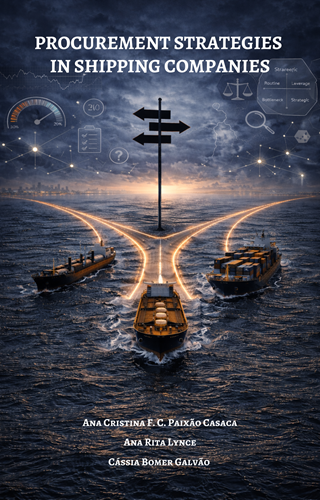
| PROCUREMENT STRATEGIES IN SHIPPING COMPANIES |
| |
| |
Ana Cristina Ferreira Castela Paixão Casaca, ‘World of Shipping Portugal’, Parede, Portugal and CIMOSM - Centro de Investigação em Modelação e Optimização de Sistemas Multifuncionais, ISEL, 1959-007 Lisboa, Portugal.  https://orcid.org/0000-0003-3925-473X https://orcid.org/0000-0003-3925-473X |
| Ana Rita Lynce,
Equimodal, Zaragoza, Spain. https://orcid.org/0000-0003-2511-4816 |
| Cassia Bomer Galvão,
Texas A&M University, College of Marine Sciences & Maritime Studies, Department of Maritime Studies, Galveston, TX, United States. https://orcid.org/0000-0001-8424-1781 |
| |
| |
| |
| SUMMARY |
| Shipping companies operate within one of the most complex and capital-intensive service industries in the global economy, where operational continuity, cost efficiency, regulatory compliance, and risk management depend heavily on procurement decisions. Unlike manufacturing firms, shipping companies deliver an intangible transport service while simultaneously relying on a wide array of tangible assets, specialised technical services, and globally dispersed suppliers. This dual service–asset dependency means that procurement extends well beyond a transactional or cost-control function and becomes a strategic determinant of service reliability, supplier dependency, cost structures, and long-term competitiveness across the shipping value chain. |
| Within this context, procurement must be understood as an integrated value-creating activity embedded in the broader organisational system. Decisions related to sourcing, supplier selection, contracting, and relationship management directly influence not only operating costs, but also vessel availability, safety performance, regulatory compliance, and exposure to operational and market risks. Given the capital intensity of ships and equipment, the global dispersion of supply networks, and the criticality of time and reliability in maritime services, procurement choices have cascading effects across operations, customer service, and financial performance. Understanding procurement through a value chain perspective is therefore essential for both scholars and practitioners seeking to navigate increasing market volatility, technological disruption, and sustainability pressures in maritime transport. |
| This monograph aims to provide a structured, industry-specific analysis of procurement strategy and supplier management in shipping companies. It begins by establishing the conceptual foundations of procurement within the value chain framework, clarifying its definition, scope, and core processes as they apply to maritime transport services. The analysis then situates shipping companies within a service–goods logistics system, identifies the principal procurement categories, and examines the varying degrees of supplier pressure along the maritime service–product supply chain. Particular attention is given to how different supplier groups influence operational continuity, cost exposure, and strategic flexibility. |
| Building on this foundation, the analysis applies established strategic management and procurement models to the shipping context, with a strong emphasis on supplier segmentation. The Kraljic Matrix is used as the central analytical tool to classify suppliers by profit impact and supply risk, while Porter’s analytical logic is integrated to assess supplier power, dependency, and strategic exposure. Clear thresholds are developed to distinguish between transactional, leverage, bottleneck, and strategic suppliers in shipping, highlighting the distinct managerial approaches and governance structures required for each category. Special emphasis is placed on identifying high-pressure suppliers and on the strategic responses necessary to mitigate risk, reduce dependency, and safeguard service continuity. |
| The final sections explore emerging trends and innovations shaping the future of procurement in shipping companies. These include the growing influence of digitalisation, sustainability and decarbonisation requirements, increasing market volatility, and rising supply chain complexity. The analysis shows how procurement strategies are evolving across different supplier categories in response to these pressures, reinforcing procurement's role as a dynamic, strategic function rather than a purely operational activity. By combining conceptual clarity with practical, industry-specific insights, this analysis positions procurement as a central pillar of value creation and competitive advantage in modern shipping companies. |
| |
| KEYWORDS |
| Shipping companies’ procurement; Procurement strategy; Supplier management; Supplier segmentation; Kraljic Matrix; Maritime logistics systems; Supply risk; Supplier power. |
| |
| |
| |
|
| |
| |
| |
ANNUAL SUBSCRIPTION |
| |
| Gain access to the WofSPortugal Knowledge Hub, a specialist digital library containing original texts on maritime transport, shipping, logistics and related fields. The content draws on my academic publications, research, teaching and extensive professional experience in the maritime sector. Subscribers will also have access to carefully selected links to complementary resources, including case studies, technical references, recommended readings, institutional publications and reliable sources of updated specialist information. |
| |
| Please note that the publication entitled Maritime Logistics. A New Curricular Unit and the Workshops are excluded from the WofSPortugal Knowledge Hub Annual Subscription and is subject to separate access conditions. |
| |
ANNUAL SUBSCRIPTION FEES |
| |
| Individual Student Subscription: €250 per year, plus VAT (Total Payable: €307.50). |
| Individual Professional Subscription: €600 per year, plus VAT (Total Payable: €738). |
| Company Subscription: €900 per user per year, plus VAT where applicable (Total Payable per User per Year: €1,107 VAT included). |
| University, Educational or Training Institutions: Quotation upon request, plus VAT where applicable. |
| Where VAT applies, Portuguese VAT will be charged at the current standard rate of 23%. Whether VAT is chargeable will depend on the subscriber’s tax status. |
| |
ACCESS AND USE |
| |
| All original materials are available exclusively for consultation through the WoSPortugal Knowledge Hub and cannot be downloaded, reproduced, printed, recorded, shared, distributed or republished without prior written authorisation. |
| Access credentials are personal and non-transferable. A subscription grants access to the WoSPortugal Knowledge Hub but does not transfer ownership or intellectual property rights to the subscriber. |
| Links to complementary external resources are provided for study and research purposes. Their content remains subject to the availability and terms established by the respective authors, publishers and organisations. |
| Each subscription is valid for 12 months from the date of activation. |
| |
SUBSCRIPTION ENQUIRIES |
| |
| Subscriptions will be available from January 2027. |
| To subscribe, please send an email to training@worldofshipping.org or fill in the form below, indicating the required subscription category. Students should prepare a valid proof of enrolment and deliver it upon request. Companies, universities and academic institutions should also specify the expected number and type of users so that an appropriate quotation can be prepared. |
| |
| |
| |
| COMPLETE YOUR SUBSCRIPTION |
| |
|
| |
| Top of the page |
| |
|
|