|
|
| |
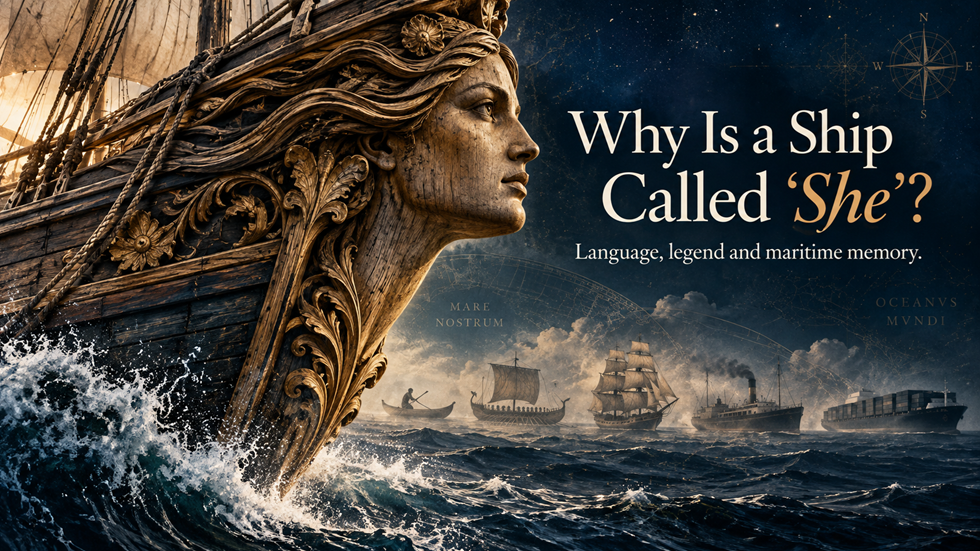
| Why is a Ship Called 'She'? |
| |
| Written by Ana Casaca |
Posted on 17 September 2026 | Updated on 19 Sptember 2026 |
Reading Time 72 minutes |
|
 |
| |
1. Introduction |
| Ships have traditionally been personified as female in English maritime language and are frequently described using the pronouns she and her. A seafarer may therefore say that a vessel has reached her port, entered service or completed her final voyage. This usage is deeply embedded in maritime culture, but it is not a grammatical requirement, nor can it be traced with certainty to a single historical origin. It appears instead to have developed through a combination of linguistic convention, cultural personification, religious symbolism and the close relationship between seafarers and the vessels on which their lives and livelihoods depended. Like many long-standing maritime expressions, its persistence reflects the interaction between language and the particular social world of those who work at sea. |
| The practice also raises an important distinction between a ship as a physical object and a ship as a social and cultural entity. Technically, a ship is an inanimate structure and may properly be called it. Within traditional maritime discourse, however, a named vessel may acquire an identity that extends beyond its hull, machinery and equipment. Its name, appearance, handling characteristics, performance, history, crew and reputation can collectively create what seafarers perceive as a distinctive character. Ships may be remembered for surviving severe storms, completing notable voyages, participating in military campaigns, carrying particular generations of passengers or crews, or becoming associated with important historical events. The feminine pronoun consequently reflects a wider tendency to transform the vessel from a technical object into an individualised presence in maritime life. |
| Naming reinforces this process of personification. Ships have been given individual names for centuries, and those names often carry religious, political, geographical, dynastic, symbolic or personal meanings. A vessel may be named after a monarch, a city, a saint, a family member, a natural phenomenon or an abstract ideal. Yet, the grammatical gender suggested by the name does not necessarily determine how the vessel is described. A ship bearing a masculine name may still traditionally be referred to as she. The association between ships and femininity must therefore be distinguished from the grammatical gender or meaning of particular ship names. It represents a broader cultural convention in which the vessel itself, rather than its name, is personified as feminine. This personification also reflects the emotional and practical relationship between seafarers and their ships. For much of maritime history, a vessel provided transport, shelter, working space and, in dangerous conditions, the principal means of survival. Crews depended upon the seaworthiness of the hull, the reliability of the rigging or machinery, and the vessel’s ability to respond to wind, waves and steering commands. Seafarers consequently developed intimate knowledge of individual ships’ behaviour and often described them in human terms: a vessel might be considered responsive, difficult, reliable, graceful, stubborn, or forgiving. Such descriptions should not be interpreted literally, but they demonstrate how technical experience could become intertwined with emotional attachment and anthropomorphic language. |
| Ideas of protection, fertility and femininity have also been proposed as possible influences upon the convention. Maritime cultures have long surrounded ships and voyages with rituals, protective symbols and religious practices intended to secure safe passage. Female deities, saints, and protective figures have appeared in several maritime traditions, while the ship itself has sometimes been represented symbolically as a nurturing or protective enclosure that carries its occupants safely across a dangerous environment. These associations may have contributed to feminine personification, although caution is required. No single historical explanation shows that ships came to be called she because of one particular goddess, religious practice, or symbolic tradition. Attempts to identify a single origin tend to oversimplify what was probably a gradual development shaped by several overlapping linguistic and cultural influences. |
| The convention must also be understood within the wider history of anthropomorphism. Human societies regularly attribute human characteristics, emotions, intentions, behaviours, or motivations to non-human beings or entities with distinctive appearances, behaviours, or emotional significance, such as animals, objects, natural phenomena, organisations, machines, or deities. Nations, natural forces, vehicles and machines have all been personified in different linguistic traditions. Ships are particularly susceptible to such treatment because they move through an unpredictable environment, respond visibly to external forces, and have distinct handling characteristics. Their long operational lives and named identities further encourage people to describe them as if they possessed continuity and personality. |
| Maritime personification is therefore not unique, although the persistent use of feminine pronouns for ships became especially characteristic of traditional English nautical usage. At the same time, maritime language has never been completely uniform. Usage has varied by country, period, occupation, institution, and context. Seafarers, shipowners, naval personnel, journalists, historians, lawyers and technical specialists have not necessarily followed identical linguistic conventions. Traditional maritime writing may favour she, particularly when discussing a named vessel in narrative or historical contexts, whereas technical, legal and administrative documents increasingly treat a ship as an inanimate object and employ it. The two usages can therefore coexist: one emphasises cultural personification and maritime tradition, while the other reflects contemporary grammatical and professional conventions. Consequently, the question is not simply why a ship is female. A ship has no biological sex, and its name does not necessarily determine the pronoun used for it. The more precise historical question is why English-speaking maritime communities came to personify ships as feminine, how that practice became embedded within nautical language and culture, and why it has endured alongside the increasing use of gender-neutral terminology. Exploring the question therefore requires consideration not only of grammar, but also of ship naming, seafaring culture, symbolism, religion, anthropomorphism, professional practice and the unusually close relationship that has historically existed between mariners and the vessels upon which they depended. |
| |
2. Historical Development: From Watercraft to the Named Ship |
| 2.1 Early Watercraft and the Beginnings of Maritime Mobility |
| The cultural personification of ships becomes easier to understand when considered against the long development of waterborne transport. The earliest crafts were not socially or technologically equivalent to the ocean-going ship. However, they established the fundamental relationship between people and a structure upon which movement, subsistence, trade and survival depended. Over thousands of years, simple crafts evolved into named vessels that carried communities, projected political power and connected distant markets. As ships grew larger, more complex, and more socially significant, they also became more readily perceived as having distinct individual identities. The earliest forms of water transport probably included floating logs, rafts [1], reed bundles, inflated animal skins and skin-covered frames. However, the archaeological record is necessarily incomplete because these materials rarely survive for thousands of years. It is therefore important to distinguish the earliest known surviving craft from the first craft ever constructed. |
| One of the oldest surviving examples is the Pesse canoe, a dugout [2] made from a Scots pine log and dated to approximately 8040–7510 BC. Its construction dates organised water transport to at least around ten thousand years before the present, although human use of simple watercraft was likely considerably older (Rassia and Tsikis, 2020). In this regard, Manning (2013) associates early waterborne travel with coastal mobility and human expansion, highlighting the use of rafts, reed boats and skin-covered craft in environments where rivers and coastlines served as corridors rather than barriers. Manning argues that while rafts and reed boats were used along the Indian Ocean coastline approximately 70,000 years ago, around 40,000 years ago, watertight, lightweight boats, constructed by stretching animal skins over wooden frames, facilitated the colonisation of temperate Eurasia along its coastlines and cold, fast-flowing rivers. |
| Watercraft also supported exchange. Archaeological evidence from the Aegean shows that obsidian from the volcanic island of Melos circulated through maritime networks during the seventh millennium BCE. The material reached communities in the Balkans, Anatolia and other parts of the eastern Mediterranean, where it was worked into blades and tools (Perlès et al., 2011; Horejs et al., 2015). Such evidence does not reveal how early mariners spoke about their craft [3], but it demonstrates that boats already connected production sites, trading communities and culturally distinct shores. The gradual development from individual logs to dugouts, rafts and constructed hulls increased carrying capacity and extended the range of waterborne movement. Once people began entrusting valuable cargo, provisions and human lives to a craft, the vessel became more than a passive platform. Reliability, handling and seaworthiness acquired immediate practical and emotional importance, conditions that would later support the personification of ships. |
| |
| 2.2 The Introduction of Sail and the Expansion of Maritime Exchange |
| The introduction of sails transformed water transport by enabling vessels to harness wind power, extend their operational range and carry larger loads than craft propelled solely by paddles or oars. Archaeological and visual evidence from Mesopotamia, Babylon, Assyria, Egypt, China and Oceania indicates that sailing and rowing technologies developed in several regions from approximately 3000 BCE onwards. Some of the earliest evidence of maritime sailing vessels comes from the Mesopotamian Ubaid period in the Persian Gulf dating from around 3500 to 3000 BCE. These boats were constructed from locally available materials, particularly bundled reeds coated with bitumen and enclosed within a supporting lattice of ropes. Although they could accommodate only small cargoes and a limited number of sailors, they participated in increasingly extensive coastal exchange networks linking Mesopotamian communities with Neolithic societies along the Arabian coast of the Persian Gulf. As sailing technology and vessel capacity subsequently developed, maritime exchange expanded across the Arabian Sea, supporting the emergence of important trading connections involving communities in present-day India, Pakistan and the Arabian Peninsula. |
| |
| 2.3 Ancient Egyptian Riverine and Red Sea Navigation |
| In Egypt, watercraft were essential for moving people, food, stone, and other materials along the Nile, the principal transport artery of ancient Egyptian society (Vinson, 2012; Peck, 2013). Early vessels included narrow, sharp-ended craft made from bundles of papyrus reeds, while papyriform features continued to influence the appearance of later wooden boats (Stephens 2012; Peck, 2013). Although these light craft had limited carrying capacity, they suited everyday river transport, fishing, and movement through marsh and riverine environments. Later, larger, more specialised vessels and barges could transport monumental stonework, including obelisks, some weighing approximately 200 to 450 tonnes. The introduction of sail propulsion significantly increased the operational capabilities of Egyptian watercraft. Iconographic evidence suggests that sails were used during the Predynastic period, probably by the Naqada II period in the fourth millennium BCE (Mark, 2013). Sails allowed vessels to exploit the prevailing northerly winds when travelling southwards against the Nile current, while oars and the river current facilitated northward movement and provided additional propulsion and control when required (Peck, 2013). These combined forms of propulsion increased the flexibility of Egyptian water transport, although early sailing rigs did not necessarily provide the manoeuvrability associated with later developments in sailing technology. |
| Because Egypt possessed relatively limited supplies of long, high-quality shipbuilding timber, early watercraft made extensive use of papyrus and other locally available materials. Nevertheless, Egyptian shipbuilders progressively developed sophisticated wooden vessels and supplemented native timber with imported wood, particularly cedar, when constructing larger craft (Ward, 2006; Stephens 2012). By the Early Dynastic period, Egyptian shipwrights were constructing substantial planked wooden vessels, as demonstrated by the First Dynasty boats discovered at Abydos, which provide some of the earliest archaeological evidence for complex wooden boatbuilding in Egypt (Ward, 2006). Their hull forms and other design features continued to reflect aspects of earlier papyrus-reed craft. Further developments produced vessels capable of coastal and longer-distance seafaring. Archaeological evidence from Mersa/Wadi Gawasis shows that Egyptian shipbuilders constructed complex seagoing vessels using established Egyptian shipbuilding techniques and imported cedar timbers, supporting voyages through the Red Sea and toward regions such as Punt (Ward and Zazzaro, 2010). Maritime contacts also extended to the Levant and the wider eastern Mediterranean, although the extent to which these contacts involved direct Egyptian voyages remains uncertain (Vinson, 2012). Navigation depended heavily on accumulated knowledge of river and coastal geography, prevailing winds, currents, landmarks, and seasonal environmental conditions. |
| Egyptian vessels also operated in the Red Sea, supporting expeditions and commercial exchanges with regions of the southern Red Sea and northeastern Africa, particularly the Land of Punt (Kitchen, 2004; Bard and Fattovich, 2015). Although the precise location and geographical extent of Punt remain debated, archaeological, textual and biomolecular evidence increasingly points to the southern Red Sea and the Horn of Africa, while not excluding connections with the Arabian side of the Red Sea (Kitchen, 2004; Dominy et al., 2020). Egyptian expeditions to this region sought valuable commodities, including incense, myrrh, ebony, and other luxury goods. Middle Kingdom [4] evidence from the harbour of Mersa/Wadi Gawasis provides particularly important evidence for Egyptian Red Sea navigation. Archaeological investigations have identified harbour installations, storage galleries, expedition equipment and ship remains associated with seafaring expeditions to Punt (Ward and Zazzaro, 2010; Bard and Fattovich, 2015). Supplies, including timber, ropes, pottery and food, were transported from the Nile Valley across the Eastern Desert to the Red Sea coast, demonstrating the logistical connection between Nile-based Egyptian society and its maritime activities in the Red Sea (Bard and Fattovich, 2015). In considerably later periods, artificial waterways were also developed between the Nile system and the Red Sea. The so-called Canal of the Pharaohs, extending through the Wadi Tumilat, was associated particularly with works undertaken under Necho II and subsequently Darius I, with later restoration and development under Ptolemaic and Roman rulers (Redmount, 1995). |
| Egypt was therefore linked, both directly and indirectly, to increasingly extensive exchange networks encompassing north-eastern Africa, the Arabian Peninsula, the eastern Mediterranean and regions farther east. Rodrigue and Notteboom state that, by approximately 1200 BCE, Egyptian ships traded as far as Sumatra, describing this as one of the longest maritime routes of the period (Rodrigue and Notteboom, n.d.). This assertion should, however, be treated with considerable caution. Insufficient archaeological evidence currently demonstrates direct Egyptian voyages to Sumatra during this period. Archaeological and biomolecular research nevertheless provides evidence for the long-distance movement of commodities between Asia and the Near East during the second millennium BCE. For example, Scott et al. (2021) identified evidence for the consumption of food products of South and East Asian origin in the Southern Levant [5], including turmeric, soybean, and probable banana. Such findings demonstrate extensive long-distance exchange networks but do not establish that Egyptian vessels transported these commodities directly from their regions of origin. Instead, goods could have passed through a succession of interconnected maritime and overland trading systems and intermediary communities before reaching the eastern Mediterranean. Moreover, the identification and geographical origins of some commodities traditionally regarded as evidence of early Asian trade remain contested, as debates over ancient cinnamon and cassia show (Haw, 2017). |
| |
| 2.4 Minoan, Mycenaean and Phoenician Maritime Networks |
| During the second millennium BCE, Minoan Crete developed extensive maritime connections throughout the Aegean and eastern Mediterranean. Crete’s geographical position between the Aegean, Egypt and the Levant, combined with its numerous natural harbours and relatively difficult overland terrain, encouraged strong dependence on maritime communication and exchange (Betancourt, 2008). From approximately 2000 BCE, the development of the Cretan palatial centres coincided with expanding commercial and cultural contacts involving the Cyclades, mainland Greece, Cyprus, Egypt and the Levant [6]. Minoan communities imported raw materials scarce on Crete and exported manufactured goods, agricultural products, and culturally distinctive objects and styles. Although later Greek traditions portrayed Minoan Crete as exercising a maritime supremacy or thalassocracy, the extent to which Cretan rulers maintained sustained political or naval control over surrounding waters remains debated. Archaeological evidence shows extensive connectivity and strong cultural influence, but this should not automatically be interpreted as evidence of a centrally controlled maritime empire (Davis, 2008; Betancourt, 2008). |
| After the Minoan palatial system weakened from approximately 1450 BCE, Mycenaean communities became increasingly prominent within Aegean maritime networks. Mycenaean seafarers participated in both local and long-distance exchange systems, linking mainland Greece and the Aegean islands with Cyprus, the Levant, Egypt, southern Italy, and Sicily. Tartaron (2013) emphasised that these connections operated at several geographical scales: spectacular long-distance exchanges formed only one component of a maritime world also characterised by dense local and regional networks connecting neighbouring coastal communities. Ships transported commodities, people and information and supported political relationships, military activity and the movement of specialised products and raw materials. Maritime connectivity therefore depended on an interacting hierarchy of local coastal routes, regional circuits and longer-distance voyages rather than on a small number of continuous routes between major political centres (Tartaron, 2013). |
| The eastern Mediterranean maritime system underwent significant disruption and reorganisation around the end of the thirteenth and beginning of the twelfth centuries BCE as several Late Bronze Age political centres, including major royal capitals, palatial centres and regional city-states across Egypt, the Levant, Anatolia, Mesopotamia and the Aegean, declined or disappeared. Egyptian, Aegean, Cypriot and Levantine maritime communities consequently operated within changing patterns of trade, migration, conflict and political authority. This period should not, however, be understood simply as the disappearance of maritime activity. Evidence indicates both disruption and continuity, with seafaring traditions, coastal communities and technological knowledge surviving and adapting to new political and economic circumstances. Ship representations, archaeological remains, and textual evidence document ongoing developments in hull construction, propulsion, steering arrangements, rigging, and shipboard organisation across the Bronze and Early Iron Age eastern Mediterranean (Wachsmann, 1998; Tartaron, 2013). Maritime technology was not the exclusive achievement of a single civilisation; rather, shipbuilding and navigation developed through prolonged interaction among Egyptian, Aegean, Cypriot and Levantine communities, alongside adaptation to local materials, cargo requirements and navigational environments. |
| Within this reorganised maritime environment, the Phoenician city-states of the Levant gradually became particularly important commercial and seafaring centres. Building on much older Levantine maritime traditions, Phoenician merchants developed networks linking cities such as Tyre, Sidon and Byblos with Cyprus and other eastern Mediterranean markets, then progressively extended their activities westwards. From the ninth and particularly the eighth centuries BCE, Phoenician commercial and settlement networks encompassed North Africa, Sicily, Sardinia, the Iberian Peninsula and other parts of the central and western Mediterranean (Aubet, 2001; Hodos, 2020). These networks were organised through ports, trading settlements and relationships with indigenous communities rather than through uniform territorial control. The Minoan, Mycenaean, Egyptian, Cypriot, Levantine and Phoenician maritime systems succession therefore illustrate the close relationship between shipbuilding, geography, technological exchange, political organisation, military requirements and long-distance commerce. It also demonstrates that Mediterranean maritime development was cumulative: later seafaring societies inherited, adapted and extended technologies and commercial practices developed through centuries of interaction among earlier maritime communities. |
| |
| 2.5 Maritime Transport in the Greek and Roman Worlds |
| Maritime transport played a fundamental role in the economic, political and territorial development of the Greek and Roman worlds. The fragmented geography of the Aegean, with its numerous islands, peninsulas and coastal settlements, encouraged extensive reliance on the sea for communication and exchange. Greek communities depended on maritime trade for commodities including grain, timber, metals and building materials, as well as manufactured and luxury goods. This dependence became particularly significant in major urban centres such as Classical Athens, whose population required substantial cereal imports and whose naval and construction programmes generated considerable demand for timber and other resources (Reed, 2003; Mackil, 2022). Ships also supported migration, colonisation, military campaigns and political communication, enabling Greek settlements and commercial communities to develop throughout the Mediterranean and Black Sea. Maritime activity was therefore closely connected with economic exchange, settlement, naval power and the geographical expansion of the Greek world. |
| Roman maritime development built upon these established Mediterranean traditions rather than replacing them. As Roman territorial control expanded, however, the scale, geographical reach and administrative organisation of maritime movement increased considerably. Shipping networks connected Italy with the Iberian Peninsula, North Africa, Egypt, the eastern Mediterranean, and the Black Sea, while other routes extended toward Atlantic Europe and northern regions. Ports served as interfaces between maritime, riverine, and terrestrial transport systems, facilitating the storage, transfer, and redistribution of commodities. Puteoli initially served as an important gateway for imports destined for Rome, while Ostia and subsequently Portus became central components of the capital’s supply system. Grain from Egypt and North Africa was particularly important. Still, Roman ships also transported wine, olive oil, fish products, ceramics, timber, metals, marble and other stone, as well as military supplies. These movements formed interconnected networks of long-distance shipping, coastal cabotage and inland distribution rather than simple direct routes between major ports (Stefanile, 2017; Arnaud and Keay, 2020; Brennan et al., 2020). |
| Warships and merchant vessels developed according to different operational requirements. Greek and Roman warships were generally long, comparatively narrow galleys that combined sail and oar propulsion. Sails were useful on longer passages when winds were favourable, reducing the physical demands on rowing crews, whereas oars provided controllable propulsion independent of wind conditions and were particularly important for acceleration, tactical manoeuvring, harbour approaches, and naval combat (Casson, 1971; Morrison et al., 2000). The rowers cannot accurately be characterised as invariably enslaved people or prisoners. Crew composition and legal status varied considerably between societies and historical periods, and both Greek and Roman fleets included free personnel performing skilled naval service (Morrison et al., 2000; Starr, 1960). Merchant vessels, by contrast, were generally broader and deeper and relied predominantly on sail propulsion. Their design prioritised cargo capacity, stability and economic efficiency rather than the speed and manoeuvrability required in naval warfare, although merchant galleys and vessels using supplementary oar propulsion also existed (Casson, 1971). |
| The expansion of maritime commerce was accompanied by increasingly sophisticated systems of ownership, finance, administration and port organisation. Greek sources distinguish between nauklēroi, who were associated with the ownership, management, or operation of merchant vessels, and emporoi, travelling merchants engaged in maritime trade. Moreover, maritime loans and contractual agreements further supported commercial activity by distributing the financial risks of seaborne commerce (Reed, 2003). Roman evidence similarly records navicularii, shipowners, merchants, boatmen and specialised port workers operating within organised commercial and state supply systems (Arnaud and Keay, 2020). Ships could also possess individual identities: Classical Athenian naval inventories, for example, recorded named triremes as identifiable units within the fleet (McArthur, 2023). Documentary, epigraphic and archaeological evidence increasingly allows individual vessels, owners, captains, crews, cargoes, routes and losses to be reconstructed. Greek and Roman shipping should therefore be understood not merely as a technological means of moving goods and people, but as an increasingly organised political, military and commercial system in which vessels operated as identifiable components of wider maritime networks. |
| |
| 2.6 Islamic Maritime Networks across the Mediterranean and Indian Ocean |
| From the seventh century CE onwards, the expansion of Islamic states and Muslim commercial communities intensified and reorganised long-established maritime connections between Asia, Africa and Europe. These developments did not create Indian Ocean trade, which had existed for centuries, but extended and strengthened networks linking the Mediterranean, Red Sea, Persian Gulf and Indian Ocean. Arab, Persian, and other Muslim merchants became prominent participants in these systems, operating alongside African, Indian, Jewish, Christian, and other trading communities and connecting maritime ports with inland markets through combinations of sea, river, and overland transport (Pearson, 2010; Ray, 2015; Prange, 2018). Water transport was particularly important for moving large quantities of goods over long distances. Still, its development cannot be explained simply by the navigability or limitations of rivers within Islamic territories. Maritime, riverine, and overland transport instead formed complementary components of wider commercial systems whose importance varied with geography, commodity characteristics, political conditions, and access to ports and markets. |
| The commercial effectiveness of these networks depended heavily on a hierarchy of ports, regional trading circuits and intermediary markets rather than on a single continuous maritime route. In the Persian Gulf and Arabian Sea, ports such as Basra, Siraf and Sohar became important commercial centres, while Qays and Hormuz gained prominence during the medieval period. Aden occupied a particularly strategic position at the junction between the Red Sea and the wider Indian Ocean and developed as an important transhipment and commercial centre (Vallet, 2017). Comparable port communities emerged along the coasts of East Africa, western India, and the Malabar Coast, where merchants, shipowners, sailors, brokers, and local authorities facilitated the movement and redistribution of cargoes (Ray, 2015; Prange, 2018). Commodities such as spices, textiles, aromatics, ceramics, timber, ivory, precious metals, and horses circulated through these interconnected systems. Goods did not necessarily travel from their point of origin to their destination aboard a single vessel or under the control of a single merchant. Instead, they frequently passed through several ports, vessels, commercial communities and modes of transport before reaching their eventual markets. Islamic maritime commerce should therefore be understood as a network of overlapping regional trading systems characterised by transhipment, redistribution and extensive interaction among culturally diverse merchant communities. |
| Navigation across these networks relied on accumulated knowledge of coastal geography, winds, currents, and seasonal weather patterns. In the Indian Ocean, the predictable seasonal reversal of the monsoon winds enabled navigators to organise voyages between the Arabian Peninsula, East Africa and the Indian subcontinent and, through interconnected eastern routes, towards South-East Asia. Sailing schedules, time spent in port and return voyages were consequently influenced by seasonal wind regimes as well as by commercial opportunities and political conditions (Pearson, 2010; Prange, 2018). Numerous types of boats and ships operated within these maritime and riverine networks, and no single vessel design characterised the Islamic maritime world. Construction techniques, hull forms, rigging and carrying capacity varied according to local shipbuilding traditions, available materials, cargo requirements and navigational environments. Maritime technology also reflected prolonged interaction among Arabian, Persian, Indian and, increasingly, Chinese traditions, illustrating the wider exchange of technological knowledge that accompanied commercial contacts across the Indian Ocean (Agius, 2008). The maritime expansion associated with the Islamic world should consequently be viewed not as the development of a homogeneous shipping system, but as the progressive integration of diverse regional traditions, ports, merchant communities, navigational practices and vessel technologies into one of the most extensive commercial networks of the medieval world. |
| |
| 2.7 Scandinavian Seafaring and Viking-Age Shipbuilding |
| Between the late eighth and eleventh centuries CE, Scandinavian seafaring societies, centred principally in regions corresponding to present-day Denmark, Norway and Sweden, developed a highly sophisticated maritime culture in which ships were fundamental to warfare, trade, migration, political expansion and communication. Scandinavian shipbuilders produced a range of specialised vessels rather than a single standardised ‘Viking ship’. These craft were generally constructed using the clinker, or lapstrake, method, in which overlapping hull planks were fastened together to create relatively light, flexible and strong hulls. Combined with a keel, shallow draught in many vessel types, oars and increasingly effective square sails, these construction techniques produced vessels suited to the varied conditions of northern European waters (Crumlin-Pedersen, 1997; Crumlin-Pedersen, 2010). Longships were relatively narrow, fast vessels designed particularly for warfare, raiding and the rapid transport of armed groups. Their comparatively shallow draught enabled some of them to approach beaches and operate in coastal and restricted waters, while larger examples were also capable of substantial open-sea passages. Archaeological evidence nevertheless reveals considerable variation even within the category of longships: Skuldelev 2, for example, was a large seagoing warship, whereas Skuldelev 5 was considerably smaller and better suited to Danish coastal waters and the Baltic (Crumlin-Pedersen and Olsen, 2002; Ravn, 2016). |
| Trade, settlement and long-distance migration required vessels with different characteristics. Broader and deeper cargo ships sacrificed some of the speed and rowing capacity of longships in favour of seaworthiness, cargo capacity and efficient sailing. The knarr represents one of the best-known forms of Viking-Age ocean-going merchant vessel. These ships had fuller hulls, substantial cargo holds, and relatively small crews, and relied primarily on sail power for long-distance navigation. Skuldelev 1, built in western Norway around the eleventh century, is interpreted as an ocean-going cargo vessel known in Old Norse sources as a knarr. Its robust construction and rounded hull provided both cargo capacity and seaworthiness suitable for navigation in the North Sea and North Atlantic. Smaller trading vessels were also important. Skuldelev 3, for example, was a coastal merchant ship with an estimated cargo capacity of approximately 4.6 tonnes and was designed principally for navigation within Danish waters and the Baltic. The archaeological record therefore demonstrates a differentiated transport system in which warships, ocean-going cargo vessels, coastal traders, fishing boats and other smaller craft served distinct but complementary purposes (Crumlin-Pedersen and Olsen, 2002; Englert, 2015). |
| The resulting maritime capability supported an exceptionally wide geographical range of movement. Scandinavian seafarers travelled to the British Isles and continental Europe, entered the Mediterranean and developed routes throughout the Baltic and along the river systems of eastern Europe. Westward expansion across the North Atlantic led to settlement in Iceland and Greenland and eventually to voyages to North America. Archaeological evidence from L’Anse aux Meadows in Newfoundland confirms the presence of a Norse settlement there during the eleventh century. Recent high-precision radiocarbon analysis has established that Norse activity occurred at the site in 1021 CE, providing the first secure calendar date for European presence in the Americas and placing Scandinavian transatlantic activity about 470 years before Columbus’s first voyage in 1492 (Kuitems et al., 2022). The settlement included timber-framed turf buildings, workshops and evidence of ironworking and ship-related activities, indicating that it functioned as more than a brief accidental landfall. It probably served as a base from which Norse seafarers explored other areas of the region. |
| The archaeological ships preserved at the Viking Ship Museum in Roskilde provide particularly important evidence for the technological and functional diversity of Viking-Age shipping. The five Skuldelev vessels, deliberately sunk in Roskilde Fjord during the eleventh century as part of a defensive barrier, comprise a large ocean-going cargo ship, two warships, a coastal trading vessel and a smaller fishing or transport vessel. Together, they show that Scandinavian maritime expansion was not based exclusively on the iconic longship, but on a diversified fleet adapted to warfare, commerce, fishing, coastal transport, and long-distance oceanic navigation. The ships also demonstrate the close relationship between vessel design, intended function and operating environment that characterised Scandinavian shipbuilding during the Viking Age (Crumlin-Pedersen and Olsen, 2002). |
| |
| 2.8 Chinese Maritime Trade and the Voyages of Zheng He |
| Chinese participation in maritime exchange considerably pre-dated the voyages of Zheng He. Connections between China, South-East Asia, and the Indian Ocean developed over many centuries and involved Chinese, South-East Asian, Indian, Persian, and Arab merchants. Following disruption during the late Tang period, maritime commerce recovered strongly during the tenth century and expanded considerably under the Song dynasty (960–1279). From 989, Chinese commercial seafaring received greater official acceptance, while ports such as Guangzhou and Quanzhou developed into major centres linking domestic production with overseas markets (Schottenhammer, 2017). Chinese ceramics, silk and other manufactured goods circulated through South-East Asian and Indian Ocean trading systems, while spices, aromatics, precious materials and other commodities moved towards China. These exchanges did not necessarily involve continuous voyages between China and distant western markets; goods frequently passed through intermediary ports and different merchant communities. Chinese maritime expansion should therefore be understood as part of an established, interconnected Asian trading system rather than as a development beginning with the Ming expeditions. |
Against this background, the seven major expeditions associated with Zheng He between 1405 and 1433 represented an extraordinary expansion of state-sponsored maritime activity. Commissioned principally by the Yongle emperor and, for the final voyage, by the Xuande emperor, the fleets travelled through South-East Asia and across the Indian Ocean to India, Sri Lanka, Hormuz and the Arabian Peninsula, with detachments reaching ports on the East African coast (Dreyer, 2007; Sen, 2017). Contemporary and later Chinese records describe exceptionally large expeditions: the first voyage is traditionally associated with more than 300 vessels and approximately 27,000–28,000 participants, including sailors, soldiers, officials, interpreters, medical personnel and other specialists. The precise composition of individual fleets nevertheless remains open to interpretation. Even greater caution is required regarding the dimensions of the largest so-called ‘treasure ships’ (baochuan). Later sources attribute enormous dimensions to these vessels, but interpretations of Chinese measurements, textual evidence, and archaeological remains remain contested, and many scholars question whether ships approaching the traditionally claimed dimensions could have been constructed and operated successfully (Church, 2005; Dreyer, 2007).
The voyages combined diplomatic, commercial, political and strategic objectives. They carried imperial envoys, gifts, and Chinese commodities abroad, while returning foreign products, diplomatic representatives, and tribute to the Ming court. Their presence reinforced the tributary relationships through which the Ming government sought to structure relations with overseas rulers, but they also participated directly in commercial exchange and occasionally used military force to intervene in regional disputes or protect Ming interests (Dreyer, 2007; Sen, 2017). The expeditions depended upon highly developed organisational and navigational knowledge. Sailing schedules were closely coordinated with the seasonal reversal of the Asian monsoon winds, which facilitated outward and return passages across the South China Sea and Indian Ocean (Deng and Li, 2011). Navigators also drew on accumulated knowledge of coastal geography, currents, stars, and sailing directions. The fleets thus represented not simply unusually large groups of ships but complex maritime organisations combining vessels of different functions, substantial workforce, navigation, logistics, diplomacy and military capability across exceptionally long distances. |
| The termination of the large state-sponsored expeditions after 1433 should not be interpreted as a simple Chinese rejection of maritime activity or evidence that China suddenly ‘turned away from the sea’. Their cessation resulted from changing political circumstances at the Ming court, the considerable fiscal demands of the voyages, bureaucratic opposition to imperial expenditure and competing priorities, including defence of China’s northern frontiers. Recent scholarship has particularly emphasised tensions between the emperors’ fiscal interests and those of the bureaucratic administration in explaining why further expeditions were abandoned (Siu, 2024). The end of the treasure fleets also did not end Chinese maritime commerce. Although the Ming government periodically restricted private overseas trade and continued to regulate maritime relations through tributary institutions, commercial seafaring persisted, and private merchants increasingly occupied areas of maritime exchange from which large imperial fleets had withdrawn. The Zheng He expeditions should consequently be understood as an exceptional phase of state-directed maritime mobilisation within a much longer history of Chinese participation in South-East Asian and Indian Ocean commerce, rather than as either the beginning or the end of Chinese maritime activity. |
| |
| 2.9 The Cog and the Hanseatic Maritime World |
| In northern Europe, the cog became a characteristic vessel of medieval maritime commerce and was particularly closely associated with the trading networks that developed around the North Sea and Baltic. The term appears in earlier medieval sources, but the recognisable seagoing form emerged mainly in the twelfth century and became increasingly important in the thirteenth and fourteenth centuries. Archaeological research suggests that the mature cog developed from earlier northern European craft used in rivers, estuaries and the Wadden Sea, probably in the region around the southern Jutland peninsula. Its emergence was associated with the growing requirement for vessels capable of undertaking longer voyages around the North Sea and Baltic coasts (Crumlin-Pedersen, 2000). The cog should not therefore be interpreted simply as a broader or enlarged Viking longship. It represented a distinct shipbuilding tradition, although technological interaction with Scandinavian cargo-vessel traditions probably contributed to its development. Its rise coincided with the expansion of northern European towns, specialised production and increasingly extensive regional trade networks (Unger, 1980; Ellmers, 1994). |
| The mature cog combined structural simplicity with considerable cargo-carrying capacity. Typical examples possessed a broad, high-sided hull, a single mast carrying a large square sail and, increasingly from the thirteenth century, a centrally mounted sternpost rudder. Archaeological examples demonstrate characteristic construction features including a relatively flat or flush-planked bottom combined with overlapping clinker-built side planking. These features differed significantly from Scandinavian clinker-built vessels, where overlapping planking generally continued throughout the hull (Crumlin-Pedersen, 2000). High sides provided substantial internal volume and increased freeboard, while the broad hull created space for bulk cargoes. A single square sail could be managed by a relatively small crew, supporting economical operation, although the rig limited manoeuvrability when sailing close to the wind. Raised structures at the bow and stern increasingly provided additional working and defensive positions, while the sternpost rudder improved steering compared with the earlier side-mounted steering oar (Ellmers, 1994; Hoffmann and Hoffmann, 2009). |
| These characteristics made the cog particularly suitable for the commercial environment associated with the Hanseatic world. Northern European trade involved large quantities of relatively bulky commodities, including grain, timber, salt, fish, wax, furs, cloth and other goods whose economic movement depended upon comparatively inexpensive maritime transport. Hanseatic trading networks connected ports from the eastern Baltic and Novgorod through Lübeck and other German cities to Bergen, Bruges and London, while additional connections extended toward Atlantic and Mediterranean markets (Postan, 1973). The cog’s combination of substantial carrying capacity and comparatively modest crewing requirements therefore offered important economic advantages. At the same time, merchants and vessels operated in an environment where piracy, warfare, and political instability remained significant concerns. Cogs could consequently be adapted for military or defensive service, and raised forecastles and aftercastles provided positions from which armed crews could defend the vessel. The distinction between merchant ship and warship was therefore less absolute than in later naval systems: a commercial vessel could be armed or converted when circumstances required it (Ellmers, 1994; Unger, 1980). |
| The Bremen cog provides the most important surviving archaeological example of this vessel type. Discovered in the River Weser in 1962 and dated dendrochronologically [7] to approximately 1380 CE, the vessel has become a reference point for the archaeological study of medieval northern European shipbuilding (Crumlin-Pedersen, 2000; Hoffmann, 2001). It measured approximately 23–24 metres in length and about 8 metres in beam, although reconstruction of its original form and performance necessarily involves some uncertainty. Estimates of its cargo capacity have consequently varied, with approximately 90–130 tonnes commonly proposed; other reconstructions of cog-type vessels indicate that larger examples could approach or exceed 200 tonnes (Ellmers, 1994). Experimental reconstructions based on the Bremen vessel have also provided evidence on the type’s sailing characteristics and seaworthiness (Hoffmann and Hoffmann, 2009). The cog’s significance therefore extended beyond any single standard design. It represented an adaptable family of cargo vessels whose carrying capacity, relatively economical operation and defensive potential supported the expansion of northern European maritime commerce and became closely associated with the commercial influence of the Hanseatic cities. |
| |
| 2.10 The Development of Navigation and Knowledge of the Ship |
| Navigation developed progressively alongside expanding maritime commercial systems. From the ancient Mediterranean and Indian Ocean worlds onwards, seafarers learned to interpret coastlines, winds, waves, currents, water depths, celestial bodies and the behaviour of birds and marine life. By the first millennium BCE, accumulated knowledge of seasonal winds, coastal landmarks, and astronomical observations already supported increasingly extensive voyages across the Mediterranean, Red Sea, and Indian Ocean. Such practices should not be characterised as merely rudimentary: they represented sophisticated bodies of practical knowledge accumulated through repeated observation, experience and transmission between generations of mariners. For many centuries, navigation remained largely dependent on this combination of environmental observation, local knowledge, and practical seamanship. Navigational instruments gradually supplemented rather than replaced these skills. The magnetic compass originated in China, where the eleventh century CE saw well-established knowledge of magnetism, and early twelfth-century records note its use for navigation. In Europe, the magnetic compass was being used for maritime navigation by the late twelfth century, with written evidence appearing around the 1180s and 1190s. However, the precise route by which the technology reached European seafarers remains uncertain. During the thirteenth and fourteenth centuries, the growing use of the compass, together with increasingly detailed sailing directions and nautical charts, contributed to more systematic navigation, particularly in the Mediterranean. |
| Navigational competence nevertheless involved considerably more than determining a vessel’s geographical position or maintaining a particular course. Mariners also learned to interpret how individual ships responded to wind direction, wave conditions, currents, steering inputs and variations in cargo distribution and loading. A heavily laden vessel could behave very differently from the same ship travelling in ballast, while changes in trim, sail configuration or sea state could substantially affect steering and performance. This knowledge came from repeated voyages rather than instruments alone and became an essential part of professional seamanship. Over time, this accumulated experience led seafarers to see individual vessels as having distinctive characteristics. A ship might be described as responsive, slow, difficult to steer, stable, lively in heavy seas or particularly dependable under certain wind conditions. These observations were grounded in genuine differences in hull form, loading, rigging and handling. Still, they also encouraged anthropomorphic descriptions of ships as having particular temperaments or characteristic ways of behaving. The language used by seafarers to describe their vessels consequently emerged not only from cultural tradition but also from prolonged practical experience of how individual ships performed at sea. |
| |
| 2.11 Portuguese and Iberian Oceanic Expansion |
| The fifteenth century marked a major expansion of European oceanic navigation, within which Portugal assumed an important pioneering role. Portuguese maritime activity, however, did not begin abruptly in 1415. Earlier Atlantic navigation included Portuguese participation in voyages to the Canary Islands. A possible Portuguese-backed expedition is associated with approximately 1336, although the evidence is inconclusive, whereas the 1341 expedition is much better documented. Sponsored at least partly by King Afonso IV and commanded by the Genoese Nicoloso da Recco and the Florentine Angiolino del Tegghia de’ Corbizzi, the latter explored the Canary archipelago with a multinational crew (Cattaneo, 2009). The conquest of Ceuta on 21 August 1415 nevertheless represents a major turning point and is conventionally used to mark the beginning of sustained Portuguese overseas expansion (Disney, 2009). Prince Henry, later known as Henry the Navigator, participated in the expedition and subsequently became an important patron of voyages into the Atlantic and along the western coast of Africa. He did not personally command most of these expeditions, nor is there convincing evidence for the traditional idea of a formal ‘School of Sagres’. The term is now generally understood as a later and largely symbolic designation rather than evidence of an organised educational or scientific institution. What appears to have existed was a broader network of navigators, pilots, cartographers, astronomers, merchants, shipowners, and shipbuilders associated, directly or indirectly, with Henry’s maritime enterprises. Within this environment, practical experience, navigational knowledge, cartographic information, and commercial intelligence could circulate and develop over time. Sagres nevertheless acquired symbolic importance because of its association with Henry and with the wider intellectual and practical framework that supported Portuguese Atlantic exploration. His historical significance therefore lay less in directing voyages personally or presiding over a formal nautical school than in his patronage, political influence, commercial interests, and sustained support for exploratory activity along the Atlantic and African coasts (Russell, 2000). |
| The continued expansion of Portuguese navigation along the African coast reflected several overlapping economic, political and religious objectives. Ceuta was connected with North African commercial systems receiving goods from trans-Saharan and eastern trade networks, and Portuguese expansion increasingly sought direct access to West African gold, ivory and other commodities, opportunities for Christian and territorial expansion, information concerning possible Christian allies and, ultimately, access to the commercial networks supplying Asian spices (Disney, 2009; Diffie and Winius, 1977). This objective should not, however, be understood simply as an attempt to replace or bypass a single ‘Silk Route’. The Silk Roads comprised a complex, continually changing system of interconnected terrestrial and maritime routes extending across Asia and linking regions of the Indian Ocean, the Middle East, and the Mediterranean. Commodities generally passed through numerous markets and intermediaries rather than travelling along a single continuous route from origin to final destination. Moreover, these networks carried far more than spices and luxury textiles: agricultural products, animal products, timber, metals, precious stones and numerous other commodities also circulated through them. |
| The demands of Atlantic exploration encouraged continuous adaptations in vessels, sailing techniques and navigational practices as Portuguese mariners encountered increasingly unfamiliar coastlines, wind regimes, currents and oceanic conditions. Progress was therefore cumulative rather than the result of a single technological breakthrough. Knowledge acquired during successive voyages could be incorporated into later expeditions, gradually improving understanding of both the Atlantic environment and the sailing strategies required to operate within it. The caravel became particularly important in this process, although Prince Henry did not invent it, nor was it created specifically for fifteenth-century Portuguese voyages of exploration. Its origins appear to lie in earlier Mediterranean maritime traditions, subsequently transmitted to and developed within the Iberian Peninsula. The precise genealogy of the vessel remains debated, but possible antecedents have been associated with Mediterranean coastal craft and with vessels designated by terms related to the Latin carabus, Greek karabos and Arabic qārib. By the thirteenth century, vessels known as caravelas were already documented in Portugal, where relatively small craft were employed for fishing and coastal activities. The fifteenth-century exploratory caravel should therefore be understood not as a wholly new invention but as the product of a longer process of adaptation in which Mediterranean shipbuilding and sailing traditions were progressively modified to meet the particular requirements of Atlantic navigation. |
| One particularly important Mediterranean inheritance was the lateen rig. Its triangular sails offered considerable manoeuvrability and enabled a vessel to sail more effectively at an angle to the wind than vessels relying exclusively on square sails. Combined with a relatively light hull and shallow draught, these characteristics made the caravel particularly suitable for reconnaissance along unfamiliar coasts, entering estuaries and rivers, and operating in areas where wind direction often required course changes. As Portuguese voyages extended progressively farther down the western coast of Africa, the vessel itself continued to evolve in response to changing operational requirements. Practical knowledge of Atlantic winds and currents accumulated alongside developments in ship design. Portuguese mariners increasingly recognised that successful oceanic navigation did not always involve following the shortest geographical route. Return passages could instead require vessels to sail well into the open Atlantic in search of favourable wind systems before turning towards Portugal. This experience contributed to the navigational practice later associated with the volta do mar (in English, Atlantic return route), in which vessels sailed away from the most direct geographical course to take advantage of favourable wind systems. Atlantic exploration consequently emerged from the interaction of inherited Mediterranean maritime traditions, Iberian shipbuilding experience, practical seamanship, and a growing understanding of Atlantic wind and current systems. |
| By the late 1430s, Portuguese voyages along the African coast employed lateen-rigged caravels (Domingues, 2009). Their relatively light construction, manoeuvrability and ability to operate comparatively close to the wind made them well suited to reconnaissance and exploratory navigation. Lateen sails did not permit a vessel to sail directly against the wind, but they enabled it to make progress to windward by sailing obliquely and repeatedly changing tack. As voyages grew longer and commercial demands increased, larger naus or carracks provided greater cargo capacity, endurance, and accommodation for oceanic commerce (Domingues, 2009; Diffie and Winius, 1977). Portuguese expansion across the Atlantic islands and African coast was correspondingly gradual. Porto Santo and Madeira are conventionally associated with Portuguese voyages of 1418 and 1419 respectively, although the precise chronology remains debated and some evidence favours dates one year later. The Portuguese encounter or rediscovery of parts of the Azores is conventionally placed around 1427, but islands resembling the archipelago appeared on earlier fourteenth-century maps, making the term ‘discovery’ problematic (Costa, 2009). In 1434, Gil Eanes successfully passed Cape Bojador after an unsuccessful attempt the previous year, demonstrating that the waters beyond it were navigable. The achievement became closely associated with overcoming medieval fears surrounding the Atlantic, often represented in Portuguese historiography by the expression Mar Tenebroso (in English, Dark Sea). Rather than literally disproving a single coherent legend, the voyage helped weaken a collection of inherited geographical assumptions and fears concerning navigation farther south (Diffie and Winius, 1977). |
| Portuguese exploration continued progressively down the West African coast. The Cape Verde Islands were encountered and identified over several voyages, not through a single uncontested act of discovery. Alvise Cadamosto, Antoniotto Usodimare, António da Noli, Diogo Gomes and later Diogo Afonso have all been associated with different phases of their exploration between the mid-1450s and early 1460s, making the period approximately 1456–1462 preferable to assigning the entire archipelago to one navigator and one date (Diffie and Winius, 1977). Prince Henry died on 13 November 1460, and Portuguese maritime expansion continued under royal and commercial initiatives that extended well beyond his lifetime. In 1488, Bartolomeu Dias rounded the southern extremity of Africa, demonstrating in practice that a navigable sea route connected the Atlantic and Indian oceans. According to the traditional account, Dias referred to the headland as the Cabo das Tormentas (in English, Cape of Storms), while King João II subsequently gave it the name Cabo da Boa Esperança (in English, Cape of Good Hope), reflecting the expectation that a maritime route to India had become attainable (Diffie and Winius, 1977). These voyages were therefore not a sequence planned and controlled entirely by Prince Henry, but part of a cumulative process spanning several generations and involving royal policy, private commercial interests, navigational experience, shipbuilding development and progressively expanding geographical knowledge. |
| The Portuguese advance formed part of a wider transformation of Atlantic navigation. On 12 October 1492, Christopher Columbus, sailing under the sponsorship of the Catholic Monarchs of Castile and Aragon, reached an island in the Bahamas known to its Indigenous inhabitants as Guanahaní, although the precise identification of the island remains debated (Phillips and Phillips, 1992). This event should not be understood as the European ‘discovery’ of an uninhabited continent. Indigenous peoples had inhabited the Americas for millennia before sustained European contact, while archaeological evidence from L’Anse aux Meadows confirms a Norse presence in Newfoundland around the beginning of the eleventh century. Timber-working at the site has been securely dated to 1021 CE, providing firm evidence of European activity in North America several centuries before Columbus’ voyages (Kuitems et al., 2022). Columbus’s four voyages nevertheless initiated sustained Castilian, and later wider European, expansion, conquest, and colonisation across the Atlantic. The Treaty of Tordesillas, signed on 7 June 1494, sought to regulate the competing Portuguese and Castilian claims that had intensified following Columbus’s first Atlantic voyage. The agreement replaced the earlier demarcation established by the papal bull Inter caetera of 1493, which had placed the dividing line only 100 leagues west of the Azores and Cape Verde Islands. King João II of Portugal rejected this arrangement and successfully negotiated a substantial westward displacement of the boundary. Under the Treaty of Tordesillas, the new line was established 370 leagues west of the Cape Verde Islands, with lands discovered or to be discovered to the east falling within the Portuguese sphere and those to the west within the Castilian sphere. |
| The Portuguese insistence on moving the line farther west was strategically important. It protected Portugal’s established interests and navigational freedom in the South Atlantic, particularly the oceanic space associated with the route around Africa towards the Indian Ocean, while also extending the area within which Portugal could claim previously unknown Atlantic territories. Significantly, the resulting demarcation placed the eastern part of the South American continent, later to become Brazil, within the Portuguese sphere several years before Pedro Álvares Cabral’s documented landfall there in 1500. This circumstance has contributed to a long-standing historical debate over whether the Portuguese Crown already possessed geographical information suggesting land existed west of the South Atlantic. Some historians have proposed that earlier Portuguese voyages or navigational intelligence may have provided such knowledge and that the westward displacement of the line was intended, at least partly, to safeguard possible Portuguese claims. However, direct documentary evidence demonstrating certain Portuguese knowledge of Brazil before 1494 remains lacking, and the argument should therefore be treated as a historical hypothesis rather than an established fact (Schwartz, 2012). What is clear is that the negotiated position of the Tordesillas line substantially strengthened Portuguese rights in the Atlantic and subsequently provided the legal-diplomatic basis for Portugal’s claim to Brazil. |
| Three years later, on 8 July 1497, Vasco da Gama departed from the Lisbon area with four vessels: the São Gabriel and São Rafael, both naus; the caravel Bérrio; and a supply vessel. The expedition comprised approximately 150–170 men and reached the vicinity of Calicut on the Malabar Coast in May 1498 (Subrahmanyam, 1997). By rounding Africa and crossing the western Indian Ocean, the voyage established a sustained direct oceanic connection between Portugal and India's commercial systems, reducing Portuguese dependence on Mediterranean and overland intermediaries without eliminating those older networks. The exceptional distances, duration and risks involved in such voyages demanded close coordination among ships, pilots, officers, crews and provisioning systems. Consequently, named vessels acquired individual service histories tied to particular journeys, successes, disasters, and losses. Within maritime narratives, the ship could therefore become more than an inanimate means of transport: it emerged as an identifiable participant in the collective experience of exploration, survival and long-distance navigation. |
| |
| 2.12 Early Modern Maritime Commerce and Global Integration |
| From the sixteenth century onwards, the geographical scope of European maritime commerce expanded substantially beyond its established Mediterranean, North Sea and Baltic networks towards the Atlantic and the wider oceanic world. Lisbon became an important gateway between Europe, Atlantic Africa, Brazil and the Portuguese commercial system in the Indian Ocean, while Seville developed as the principal administrative and commercial centre of Castilian trade with the Americas. The establishment of the Casa de la Contratación in Seville in 1503 reinforced the city’s privileged position within the Spanish Atlantic system, attracting merchants and linking American silver and colonial commodities with commercial networks extending across Europe (Crailsheim, 2010). Cádiz gradually gained importance during the seventeenth century as larger ocean-going vessels found its maritime location more convenient than navigating up the Guadalquivir to Seville; in 1680 it became the principal authorised point of departure for the Indies fleets, and in 1717 the Casa de la Contratación was formally transferred there. These developments illustrate a broader redistribution of commercial activity rather than the replacement of older centres by new ones. |
| A similar redistribution occurred in north-western Europe. During the first half of the sixteenth century, Antwerp emerged as one of Europe's foremost commercial and financial centres, connecting English textiles, German metals, Portuguese spices and sugar, Mediterranean commerce and northern European markets. From the end of the fifteenth century, Portuguese overseas goods increasingly flowed through Antwerp, and the city also became an important centre for credit, exchange, and marine insurance (Gelderblom, 2013; Puttevils and Deloof, 2017). Political and military disruption during the Dutch Revolt, particularly the capture of Antwerp in 1585 and subsequent restrictions on navigation of the Scheldt, contributed to the transfer of commercial and financial activity towards the northern Netherlands. Amsterdam subsequently emerged as a major centre of European and global commerce during the seventeenth century. This Atlantic and north-west European expansion did not, however, bring Mediterranean or Baltic commerce to an abrupt end. Venice, Genoa, Livorno and Ottoman ports remained active within Mediterranean networks, while Baltic trade continued to supply western European economies with grain, timber, hemp, flax, pitch, tar and other strategically important naval stores. Similarly, changes in Ottoman commercial power cannot be explained simply as the consequence of Portuguese navigation around the Cape of Good Hope. Mediterranean and Ottoman commerce adapted to changing competition, political conflict, fiscal pressures and the arrival of French, English and Dutch merchants within older Levantine networks (Tracy, 2015). |
| Portugal and Spain initially occupied important positions in European overseas expansion, although their maritime systems developed differently. The Portuguese Estado da Índia established a dispersed network of ports, fortresses and commercial connections extending from the East African coast and Persian Gulf to India, South-East Asia and, eventually, East Asia (Subrahmanyam and Thomaz, 1991). The Spanish monarchy, by contrast, developed an Atlantic system centred principally on the Americas, while its expansion into the Philippines eventually created a trans-Pacific commercial connection between Asia and New Spain. The viability of this trans-Pacific system, however, depended on solving a fundamental navigational problem: identifying a reliable eastward return route across the Pacific. After Spain established a permanent presence in the Philippines in 1565, it overcame this problem through the tornaviaje, demonstrated that same year by Andrés de Urdaneta. However, the viability of this trans-Pacific system depended on solving a fundamental navigational problem: identifying a reliable eastward return route across the Pacific. |
| After Spain established a permanent presence in the Philippines in 1565, Andrés de Urdaneta overcame this problem that same year with the tornaviaje. The route involved sailing northwards from the Philippines to reach the prevailing westerly winds of the North Pacific, which could then carry vessels eastwards towards the coast of North America. This made regular two-way navigation across the Pacific practicable. After Manila became the principal Spanish colonial and commercial centre in the Philippines in 1571, regular Manila–Acapulco crossings developed, establishing a sustained commercial link between Asian trading networks and the Spanish American economy. The Manila galleon system carried American silver west to Manila, where it was exchanged for Chinese and other Asian manufactures, including silks, porcelain, textiles, and spices, which were then transported east to New Spain. From Acapulco, many of these commodities entered wider American markets and, through overland connections and Atlantic shipping, circulated within the broader Spanish imperial economy (Cane, 2020). Manila consequently functioned not simply as a Spanish colonial port but as an intermediary between the commercial systems of Asia and the Americas. These trans-Pacific exchanges depended heavily upon Chinese and other Asian merchants, producers and established regional trading networks that supplied the goods entering the galleon trade. Iberian maritime expansion therefore did not create global exchange from nothing; rather, it connected European imperial shipping and American silver flows with pre-existing Asian and American commercial worlds, contributing to an increasingly interconnected Atlantic and Pacific trading system. |
| During the seventeenth century, the Netherlands, England and France developed increasingly extensive commercial, colonial and naval systems of their own. The English East India Company was chartered in 1600 and the Dutch Vereenigde Oost-Indische Compagnie (VOC) in 1602, while French participation became more significant later in the century. By approximately 1700, Dutch and English companies had acquired powerful positions in particular sectors of Indian Ocean and Asian commerce, although they continued to operate alongside Asian, Armenian, Arab, Persian, Indian and other merchant communities rather than replacing them (Tracy, 2015). European maritime networks increasingly connected the Mediterranean, Baltic, Atlantic, Caribbean, Indian Ocean and Pacific worlds through movements of commodities, bullion, ships, information and people. These systems were not exclusively commercial. Maritime expansion supported territorial conquest, naval warfare and colonial administration and was closely connected with plantation economies, forced migration and the transatlantic slave trade (Eltis and Richardson, 2010). Early modern maritime integration should therefore be understood as a complex interaction between commerce, state power, private enterprise and coercion rather than simply as the geographical expansion of European trade. |
| |
| 2.13 Dutch Commercial Ship Design and the Evolution of Sailing Rigs |
| Towards the end of the sixteenth century, Dutch shipbuilders developed increasingly specialised vessels adapted to different commercial environments and cargo requirements. Among the most influential was the fluyt or fluit, traditionally associated with Hoorn and with developments around 1595. Designed principally for commercial carriage rather than naval combat, the fluyt devoted a relatively large proportion of its hull to cargo capacity and dispensed with much of the heavy armament and structural reinforcement characteristic of contemporary armed merchant vessels. Its comparatively simple rig and relatively small crewing requirements helped reduce operating costs, while its capacious hull made it particularly effective for carrying bulk commodities. The type became strongly associated with Dutch trade in the Baltic and North Sea before being employed on wider European and oceanic routes. The fluyt's economic importance therefore lay not simply in its dimensions, but in the combination of cargo capacity, economical crewing, and specialised commercial design that contributed to the competitive strength of seventeenth-century Dutch shipping (Unger, 1978; Bruijn, 1990). |
| Another important Dutch vessel was the pinas, commonly rendered in English as pinnace, although the terminology requires caution because neither term consistently referred to a single standardised vessel design. During the seventeenth century, the Dutch pinas could be a substantial two- or three-masted armed merchant vessel capable of undertaking long-distance commercial voyages and, when required, naval or military service. Nicolaes Witsen's influential treatise on Dutch shipbuilding, published in 1671, used a pinas of 134 Amsterdam feet as a representative vessel to describe contemporary construction practices, illustrating the type's importance in Dutch shipbuilding (Hoving, 1988a; 1988b). Dutch terminology nevertheless remained flexible, and vessels described as pinassen could vary considerably in dimensions, rig and function (Parthesius, 2010). The large Dutch pinas should therefore be distinguished from the ship's pinnace in English maritime terminology: the latter was a smaller auxiliary boat carried aboard a larger vessel and used to transport personnel, stores, messages, and equipment, as well as for surveying, landing parties, and communication between ship and shore. |
| The rigs carried by early modern Dutch vessels likewise varied by vessel size, function, and period. Larger fluyts, pinassen and other ocean-going vessels employed rigs in which square sails played a prominent role, particularly on the foremast and mainmast, while additional fore-and-aft sails improved balance and handling under certain conditions. Square sails provided efficient propulsion when sailing with favourable winds and were therefore well suited to many long-distance oceanic routes, but predominantly square-rigged vessels were less effective when required to sail close to the wind. Fore-and-aft sails, including staysails and, in later sailing vessels, gaff sails, improved manoeuvrability and could assist progress to windward. In modern terminology, many large traditionally rigged sailing vessels may be described broadly as tall ships, but the expression does not identify a specific historical vessel type or sail plan. Full-rigged ships, barques, barquentines, brigs and schooners can all fall within the broader modern category of tall ships while retaining technically distinct rigs and vessel classifications. |
| A later expression of the large commercial sailing tradition appeared during the nineteenth and early twentieth centuries in vessels commonly described as windjammers. The term became associated particularly with large commercial sailing ships that continued to transport bulk cargoes over long oceanic routes despite the increasing dominance of steam propulsion. Many were constructed of iron or steel and carried three, four or occasionally five masts, allowing substantial sail areas to be combined with increasingly efficient rigging systems. A considerable proportion were barques, but windjammer and barque are not synonymous. A barque is a recognised class or type of sailing ship defined principally by its rig. In its established nineteenth-century form, it has three or more masts, with all masts except the aftermost square-rigged and the aftermost carrying fore-and-aft sails. Earlier uses of the terms barque and bark were broader and could refer more generally to sailing vessels, but the designation gradually acquired this more specific technical meaning. A full-rigged ship, by contrast, carries square sails on all its principal masts, whereas a barquentine normally carries square sails only on the foremast and fore-and-aft sails on the remaining masts. The barque became especially important in long-distance commercial shipping because its sail plan retained much of the favourable-wind performance and carrying efficiency associated with square-rigged ships while reducing the number of labour-intensive square sails and, consequently, the crew required to handle them. Thus, barque identifies a particular class of sailing ship, while windjammer is a broader historical description that can encompass barques as well as other large commercial sailing-vessel types. |
| |
2.14 Steam Propulsion, Metal Hulls and the Canal Age
|
| Steam propulsion transformed maritime transport from the late eighteenth century onwards, although its widespread adoption in seagoing commerce occurred principally during the nineteenth century. By reducing dependence on prevailing winds, steam power progressively allowed voyages to be planned with greater regularity and predictability, an increasingly important advantage for passenger services, mail transport and scheduled cargo operations. Early steamships commonly employed paddle wheels mounted on either side of the hull or, in some designs, at the stern. Paddle propulsion proved particularly effective on rivers, lakes and sheltered waters, but exposed wheels were vulnerable in heavy seas, occupied valuable space along the sides of the vessel and imposed constraints on hull design and cargo arrangements. The screw propeller gradually emerged as a more effective alternative for many seagoing vessels. Positioned below the waterline, it was better protected from waves and external damage, interfered less with the upper hull arrangement, and could be integrated more effectively with increasingly powerful marine engines. Its adoption nevertheless formed part of a gradual technological transition rather than an immediate replacement of earlier propulsion systems. Sail and steam coexisted for much of the nineteenth century, and many early steamships retained auxiliary sails to supplement engine power, reduce fuel consumption under favourable conditions and provide a reserve means of propulsion in the event of machinery failure. |
| Parallel developments in shipbuilding and marine engineering reinforced steam propulsion's impact. The progressive introduction of iron and, later, steel hulls enabled vessels to become larger and structurally stronger, while improvements in marine engines increased power, reliability and fuel efficiency. Advances in navigation, steering systems and mechanical cargo-handling equipment further improved operational performance and encouraged increasing specialisation among vessel types. Together, these developments expanded carrying capacity, reduced voyage uncertainty and contributed to the emergence of more regular and integrated maritime transport services. Major infrastructure projects further reshaped established trading routes. The opening of the Suez Canal in 1869 created a direct maritime connection between the Mediterranean and the Red Sea, substantially shortening many voyages between Europe and Asia by providing an alternative to the route around the Cape of Good Hope. Its importance increased further as steam propulsion became more widespread, since steamships were less dependent than sailing vessels on wind conditions within the relatively narrow canal and adjoining seas. The opening of the Panama Canal in 1914 produced a comparable transformation in the Americas by linking the Atlantic and Pacific oceans and allowing canal-capable vessels to avoid the considerably longer and often hazardous passage around Cape Horn. These canals, together with advances in propulsion and ship construction, contributed to a major reorganisation of global maritime routes and the economics of long-distance shipping. |
| |
2.15 Modern Global Shipping and the Persistence of Ship Personification
|
| These technological and infrastructural developments strengthened shipping's central position within the expanding global economy. Maritime transport increasingly connected geographically dispersed centres of production and consumption and became essential for moving raw materials, manufactured products, foodstuffs, fuels, and other commodities. Its principal advantages included high carrying capacity, extensive geographical reach and the ability to transport bulk, containerised and specialised cargoes efficiently over long distances. Today, maritime transport carries approximately 80 per cent of international trade by volume and more than 70 per cent by value. Shipping has also become one of the world's most internationalised industries: a vessel may be owned in one country, registered in another, financed elsewhere, crewed by personnel of several nationalities and operated within trading networks extending across multiple jurisdictions. The modern ship consequently functions as both a physical transport unit and a component of a complex international system of commerce, finance, regulation and logistics. |
| Despite this increasing scale, internationalisation and technological sophistication, ships did not become entirely impersonal units of transport. Seafarers continued to refer to steamships, naval vessels, passenger liners and modern merchant ships as she and her, maintaining a linguistic convention that had developed during earlier periods of maritime history. The persistence of this usage reflects the continuing perception of the vessel as a named social entity rather than merely a combination of hull, machinery and equipment. A ship remained simultaneously a workplace, a temporary home, a commercial asset and a protective structure upon which the safety and livelihoods of those on board depended. Individual vessels also accumulated histories through their voyages, crews, cargoes, incidents and achievements, reinforcing their distinct identities. Technological progress therefore altered the construction, propulsion and operation of ships without entirely removing the cultural relationship between seafarers and their vessels. Few other constructed objects combine such substantial capital value, technological complexity, prolonged human dependence and continuous exposure to the forces of the natural environment. |
| |
3. The Linguistic, Cultural and Historical Foundations of Ship Personification |
| The traditional use of she and her for ships cannot be traced with certainty to a single origin. It is better understood as the product of several overlapping influences: the history of gender in English, the personification of named objects, the close relationship between seafarers and their vessels, religious and protective symbolism, ship-naming practices, figureheads, ceremony and inherited maritime custom. Some frequently repeated explanations, particularly comparisons between ships and supposedly feminine qualities, are later rationalisations rather than reliable accounts of how the convention began. A balanced explanation must therefore distinguish historical and linguistic evidence from maritime folklore. |
| |
| 3.1 Scope and Terminology |
| The words vessel, ship and boat are frequently used as though they were interchangeable, but they are not exact synonyms. Their meanings vary by ordinary maritime usage, historical convention, naval practice, legislation, and the particular technical or regulatory context in which they appear. In general, maritime language often uses vessel as the broadest and most neutral of the three terms, and it may encompass ships, boats, and other forms of waterborne craft. A ship normally denotes a comparatively large or operationally complex vessel designed for sustained navigation and capable of carrying people, cargo or equipment, whereas boat more commonly denotes a smaller craft. These distinctions are useful as general conventions, but they do not establish universal technical or legal categories. |
| A ship is therefore not distinguished from a boat simply by exceeding a particular length, tonnage or operating distance. Ships are commonly associated with substantial hulls, greater carrying capacity, larger crews and more complex operational systems, and the term encompasses categories such as merchant ships, passenger ships, warships, research ships and specialised service ships. Nevertheless, institutional and historical conventions can override apparent size differences. Submarines, for example, have traditionally been referred to as boats in several naval traditions despite the dimensions and operational complexity of modern examples. Conversely, relatively small commercial units may formally be described as ships or vessels. A boat may also be fully capable of offshore or oceanic navigation. The distinction between ship and boat should consequently be understood as contextual rather than as a universally measurable boundary. |
| The term craft is still more flexible. In maritime terminology, it can refer to boats, vessels or specialised waterborne units and appears in expressions such as landing craft, patrol craft, pleasure craft and small craft. Watercraft similarly provides a broad descriptive category for structures or devices intended to operate on or through water. Such terminology is particularly useful when discussing early maritime history, since applying modern distinctions between ships and boats to ancient watercraft may be anachronistic. Dugouts, reed boats, rafts, skin boats and other early forms of water transport developed within societies that did not necessarily classify vessels according to the categories used in modern shipping. Historical vessel terminology could instead reflect construction method, hull form, propulsion, sail plan, geographical origin or function. The same caution applies to later historical ship types. Terms such as galley, cog, caravel, galleon, fluyt, pinas, barque and schooner do not belong to a simple hierarchy of increasing vessel size. Some primarily identify a construction or hull tradition, others a function or historical type, and still others are defined principally by their rig. Their meanings may also change over time. Barque, for example, was formerly used more broadly but eventually became a recognised class of sailing ship defined principally by a particular rig: three or more masts, with the aftermost fore-and-aft rigged and the preceding masts square-rigged. Historical maritime terminology must therefore be interpreted within its own geographical and chronological setting rather than through a modern ship-versus-boat distinction. |
| Legal terminology adds another layer of complexity because no internationally uniform hierarchy places vessel, ship, and boat in the same positions. United States federal law provides a particularly clear example. Under the United States Code, a vessel includes every description of watercraft or other artificial contrivance used, or capable of being used, as a means of transportation on water (United States Code, 2026a; United States Code, 2026b). Consequently, the term functions as a very broad statutory category. To complement this definition, the United States Code Title 46 establishes numerous subsidiary categories by function, tonnage, propulsion, and operating status rather than creating a general legal division between ships and boats (United States Code, 2026c). These include passenger vessels, small passenger vessels, recreational vessels, tank vessels, towing vessels, public vessels and uninspected vessels. Likewise, 33 CFR §175.3, for the relevant United States Coast Guard boating regulations, defines boat as a vessel manufactured or used primarily for non-commercial use, leased or chartered for such use, or operated as an uninspected passenger vessel (United States, 2026d). The United States legislation also demonstrates why apparently precise numerical distinctions must be interpreted within their statutory purpose. Under 46 U.S.C. §2101, the categories passenger vessel and small passenger vessel use a threshold of 100 gross tons subject to the detailed conditions specified in the legislation, namely passenger and operational criteria (United States Code, 2026c). This means that a small passenger vessel is generally below 100 gross tons, whereas a passenger vessel is generally at least 100 gross tons. However, it does not mean that a vessel below 100 gross tons is legally a boat and one above that threshold is legally a ship. The threshold separates particular regulatory categories of passenger vessels. In this context, the distinction turns principally on regulatory function and use rather than a universal size criterion. |
| International collision regulations similarly favour vessel as an encompassing operational term. Rule 3(a) of the Convention on the International Regulations for Preventing Collisions at Sea (COLREGs) defines vessel broadly as including every description of watercraft used or capable of being used as a means of transport on water (International Maritime Organization, 2026). The current wording also expressly includes non-displacement craft, wing-in-ground craft and seaplanes, reflecting subsequent amendments to the Convention (International Maritime Organization, 2026). The purpose of this definition is navigational: the COLREGs require a sufficiently broad category to determine which craft are subject to collision-avoidance obligations. The definition should therefore not be interpreted as establishing a universal lexical distinction between ships and boats outside the regulatory context of the Convention. British legislation illustrates this point particularly clearly: the apparent hierarchy can even be reversed. Section 313 of the Merchant Shipping Act 1995 provides that, unless the context otherwise requires, ship includes every description of vessel used in navigation (The National Archives, 1995). Within that statutory framework, ship therefore functions as an encompassing legal category rather than merely as a subcategory of vessel. The same Act also shows the context-specific nature of dimensional thresholds: for particular British-ship registration provisions in section 1, a small ship is defined as a ship less than 24 metres in length (The National Archives, 1995). The legislation does not thereby establish that craft below 24 metres are boats or that those above 24 metres are ships; it creates a particular category of small ship for a specified legislative purpose. |
| These examples demonstrate an important general principle of maritime terminology: statutory definitions apply within the scope of the instrument that creates them. A term may therefore carry one meaning in collision-avoidance rules and another in legislation governing registration, passenger-ship inspection, recreational boating, pollution prevention, taxation, crewing or employment. Legal definitions are usually drafted to serve a specific regulatory purpose, and they should not automatically be transferred from one context to another. This also explains why numerical thresholds must be treated with caution. A particular length, gross tonnage, passenger capacity, displacement or operating area may determine whether a vessel falls within a defined regulatory category, but it does not necessarily determine whether that craft is universally a ship or a boat. The same vessel may be described differently under separate legal instruments because each instrument addresses different risks, responsibilities, or administrative requirements. |
| Classification may also depend on function, propulsion, construction, use, trading pattern or whether the vessel is engaged in commercial or recreational activity. Maritime terminology is therefore relational rather than absolute. Words such as ship, boat and vessel acquire their precise legal significance from the context in which they are used. Ordinary maritime language may favour one term, while the applicable legislation adopts another. Historical usage can differ again. For this reason, legal interpretation should not rely solely on everyday understanding or on assumptions derived from vessel size. Where terminology affects legal status, certification, liability, safety obligations or regulatory compliance, the relevant convention, statute or regulation should therefore be consulted directly. The correct question is not simply whether a particular craft is ‘really’ a ship or a boat, but how the applicable legal instrument defines and classifies it for the purpose under consideration. |
| For the present discussion, the terms are therefore used principally in their general maritime and historical senses rather than as universal legal classifications. Vessel is employed as a broad and relatively neutral term where no particular type or size is intended; ship generally refers to a substantial vessel intended for sustained navigation, transport or specialised maritime operations; boat normally denotes a smaller craft, while recognising numerous historical, naval and legal exceptions; and craft or watercraft provides a flexible expression where a more inclusive category is required. These working definitions are adopted for clarity and should not be interpreted as overriding definitions contained in particular legal instruments. This distinction is especially important to the present examination of maritime personification. Ship is used as the principal term because the feminine pronouns she and her are most firmly associated with ships in traditional English maritime language. This does not mean that only large seagoing ships may be personified. Named boats, yachts, naval craft and other vessels may also be referred to as she, particularly by their owners, crews or maritime communities. Conversely, a ship is not grammatically required to be feminine. Contemporary technical, legal, regulatory and institutional writing increasingly uses it or repeats the vessel's name. The distinction considered here is therefore cultural and linguistic rather than biological, grammatical or legal: it concerns the historical tendency of English-speaking maritime communities to attribute an individual identity to ships and other named vessels. |
| |
| 3.2 The Linguistic Background |
| Modern English normally uses he and she for people and it for inanimate objects. The application of she to a ship is therefore not ordinary grammatical agreement but an instance of metaphorical gender or personification. Curzan (2003) places this usage within the broader category of ‘irregular agreement’, where pronoun choice reflects cultural personification rather than the referent’s natural gender. It presents the vessel as an individual possessing identity and character rather than as an undifferentiated object. One common explanation traces this usage to Latin navis, meaning ‘ship’, which is grammatically feminine. This fact may have encouraged later comparisons, especially among writers familiar with Latin, but it cannot explain the English convention alone. The English word ship does not derive from Latin navis: it descends from Old English scip and related Germanic forms. More importantly, scip was grammatically neuter, not feminine. Old English had masculine, feminine, and neuter noun classes, but this system largely disappeared in Middle English. The feminine treatment of ships in later English cannot therefore be described as the uninterrupted survival of the Old English noun’s grammatical gender (Curzan, 2003; Hogg and Fulk, 2011). |
| Cross-linguistic comparison further demonstrates the limits of the Latin explanation. The grammatical gender of words for ships and boats varies both between and within languages. German Schiff is neuter; French navire and bateau are masculine; Spanish barco and buque are masculine; and Portuguese navio is masculine, although other nautical nouns may be feminine. Grammatical gender is a property of a noun within a particular language and does not necessarily mean that its speakers conceptualise the object as biologically or culturally male or female. Nor does grammatical gender automatically determine the pronoun a speaker selects in English. Written evidence nevertheless shows that the feminine treatment of ships has a long history in English. The Oxford English Dictionary dates the usage to at least 1375 (cited in Barnes, 2002), and by the early modern period it was established enough to be described as an exception to the ordinary treatment of inanimate nouns. In The English Grammar, published posthumously in 1640, Ben Jonson observed that inanimate objects were normally neuter but that a ship was an exception: speakers said that ‘she sails well’ even when the vessel bore a masculine name. This is important evidence for the convention’s existence, but it does not explain why it arose (Jonson, 1928 [1640]). The linguistic evidence consequently supports a limited conclusion. Older systems of grammatical gender and contact with other European languages may have made gendered reference to objects familiar. Still, neither Latin nor any single source language provides a complete causal explanation. In English, she became a conventional form of personification sustained by maritime usage. |
| |
| 3.3 Ships as Personified Vessels |
| Personification attributes human identity, motives, emotions or behaviour to something non-human. A ship is especially susceptible to this treatment because it is named, launched, commissioned, maintained and eventually withdrawn from service. It also has a recognisable form and history, responds visibly to wind, waves, loading and steering, and may appear to behave differently under changing conditions. Mariners commonly speak of a vessel as lively, stubborn, steady, forgiving or difficult. Such descriptions translate complex physical responses into the language of character. The practical and emotional conditions of life at sea reinforced this tendency. A ship was simultaneously a means of transport, a workplace, a temporary home, a valuable asset and the structure upon which the lives of those aboard depended. Crews maintained it, learned its distinctive movements and limitations, and shared dangers with it over long voyages. |
| Referring to the vessel by name and with a personal pronoun acknowledged this continuing relationship. The convention could operate even when a ship had a masculine, geographical or abstract name, because the pronoun referred to the personified vessel rather than to the grammatical or natural gender suggested by its name. Personification also gave a complex organisation a single identity. A ship brought together its hull, machinery or rig, cargo, officers and crew as one functioning unit. It could acquire a reputation, a record of service and associations with particular voyages, battles, rescues or losses. In this sense, the ship was not merely an object owned by an individual or institution; it became a named social entity around which collective memory and loyalty could form. This helps explain why personifying language persisted when wooden sailing ships were replaced by iron and steel steamships and, later, by technologically sophisticated naval and commercial vessels. |
| |
| 3.4 Protection Motherhood and Maritime Belief |
| The idea of the ship as a protective female or maternal figure is one of the most persistent explanations for the pronoun she. A vessel encloses and carries its occupants through an environment they could not survive without. This protective function has encouraged comparisons with shelter, nurture and motherhood. Seafarers and later commentators have described the ship as caring for those aboard, provided that they care for and maintain it in return. The metaphor expresses dependence and reciprocity more clearly than it establishes a historical origin. Religious belief and maritime superstition also contributed to the symbolic environment in which ships were personified. Seafaring cultures appealed to deities, saints and other protective figures for favourable weather and safe passage. Some of these figures were female, and ships were sometimes dedicated to or named after them. Santa María, for example, is a religious name associated with the Virgin Mary. However, ancient and early modern maritime belief was culturally diverse: protectors of sailors included male as well as female gods, saints and heroes. It would therefore be inaccurate to claim that all ships were originally dedicated to goddesses or that goddess worship alone produced the English pronoun. |
| The maternal interpretation also existed alongside the superstition that women aboard a ship could bring misfortune. That apparent contradiction illustrates why maritime beliefs should not be forced into a single coherent explanation. Superstitions varied by time, place, and community, and women were never wholly absent from seafaring. These beliefs are relevant because they reveal how gender was imagined within historically male-dominated maritime environments, but they do not constitute proof of the pronoun’s origin. Naming and launching ceremonies perpetuated the protective symbolism. A sponsor or ‘godmother’ might formally bestow the vessel’s name and express a wish for the safety of the ship and those aboard. The traditional British blessing, ‘May God bless her and all who sail in her’, explicitly links the vessel’s feminine identity to the protection of its occupants (Barnes, 2002). Breaking a bottle against the hull became a familiar element of modern launching ceremonies, although practices differed across periods and cultures. Such rituals mark the symbolic transition from a constructed hull to a recognised vessel with an individual identity. Ceremonial language consequently helped transmit the feminine convention even after its religious significance had weakened. |
| |
| 3.5 Ships' Names |
| Ship naming gives a vessel an individual identity and distinguishes it from other vessels of the same class or function. Names may commemorate women or men, rulers, relatives, saints, deities, places, battles, virtues, natural phenomena or abstract ideas. Naval naming systems are often institutional and may associate particular classes of ship with monarchs, cities, regions or martial qualities. Commercial owners may select names connected with a company, family, route or marketing identity. It is therefore incorrect to assume that ships are invariably, or even necessarily, given female names. The relationship between a ship’s name and the pronoun used to refer to it is not straightforward. In The English Grammar, first published posthumously in 1640, Ben Jonson classified inanimate things as neuter. Still, he explicitly made ‘a ship excepted’, observing that speakers said ‘shee sayles well’ even when the vessel bore a masculine name, such as Hercules or Henry. His observation shows that feminine pronominal reference to ships was already established in English by the early seventeenth century (Jonson, 1928 [1640]). However, it documents the convention rather than explaining how or why it arose. The distinction between naming and pronominal gender has persisted. HMS Queen Elizabeth and HMS Prince of Wales, for example, were both referred to using feminine pronouns during their official naming ceremonies, despite the different genders expressed by their names (Ministry of Defence, Defence Equipment and Support and Office of the Secretary of State for Scotland, 2014; QEClassCarriers 2017). Conversely, giving a vessel a female name does not require a modern writer to refer to it as she. In traditional English maritime usage, the feminine pronoun refers to the personified vessel rather than agreeing grammatically with the gender suggested by its proper name. Ship naming and ship personification may therefore reinforce one another, but they are distinct linguistic and cultural practices. |
| |
| 3.6 Figureheads |
| Figureheads provided a visible and highly symbolic expression of a ship’s identity. Usually carved from wood and mounted at the prow, they could represent a person, animal, heraldic emblem, religious figure, mythical creature or allegorical character associated with the vessel’s name, ownership, nationality or intended qualities. Their origins preceded the European age of sail by many centuries. Ancient maritime cultures decorated vessels with painted eyes, animal heads and carved human or divine figures, while later European traditions developed increasingly elaborate forms of bow decoration. By the seventeenth and eighteenth centuries, figureheads had become a conspicuous feature of many European naval and merchant vessels, although their form, scale and complexity varied considerably according to the type and status of the ship. The subject represented by a figurehead could reinforce the meaning of the vessel’s name but did not necessarily reproduce it literally. Monarchs, military heroes, saints, classical deities, warriors, lions, eagles, unicorns and other symbolic figures could communicate ideas of sovereignty, courage, aggression, protection or national power. In merchant shipping, figureheads could portray historical personalities, literary or legendary figures, members of the shipowner’s family or even the owner himself. Royal Navy practice also changed over time: for example, the lion was a conventional bow decoration for many smaller warships from around 1600, but during the eighteenth century it was increasingly replaced by human figures, including figures in classical dress. |
| Figureheads also carried meanings beyond formal naming. To crews, they could function as protective or auspicious objects and were sometimes regarded as embodying the spirit of the ship or symbolically guiding it through dangerous seas. Such beliefs gave the figurehead an emotional as well as decorative significance, and surviving accounts indicate that crews could become strongly attached to these carvings. Their prominent position at the bow also gave vessels a readily recognisable visual identity at a time when maritime culture relied heavily on heraldry, colour, symbols and imagery as well as written names. Female figures became particularly prominent and included goddesses, allegorical women, historical personalities and mermaids, but female representation was never universal. Male monarchs, warriors and other masculine figures were equally compatible with the tradition, while animals and heraldic forms were also widespread. Surviving examples include representations of kings, male shipowners and figures such as Neptune alongside numerous female subjects. The prevalence of female figureheads should therefore not be treated as evidence that ships themselves were necessarily given female names, nor as the original explanation for the English convention of referring to ships as she. Female figureheads are better understood as one manifestation of a broader tradition of maritime personification. |
| The importance of figureheads also changed with developments in naval architecture. By around 1700, ornamental carving on European warships had become considerably more elaborate, but naval authorities later began restricting costly, extensive decoration, particularly on lower-ranking vessels. Figureheads nevertheless remained prominent throughout the age of sail and experienced renewed popularity on nineteenth-century merchant vessels and clippers. Their survival across changing vessel types shows they were more than ornamental additions: they formed part of the cultural process through which a constructed object acquired individual character and social identity. Names, figureheads and pronouns should therefore be regarded as related but distinct forms of maritime personification. A name provided linguistic identity, a figurehead made that identity visually and symbolically tangible, and the use of personal pronouns extended personification into language. None of these practices alone explains the others. Together, they illustrate the long-standing tendency within maritime cultures to treat ships not merely as technical objects but as individual vessels with recognisable identities, associations, and symbolic meanings. |
| |
| 3.7 The Limits of Traditional Explanations |
| Many popular accounts offer a list of reasons why a ship is supposedly female: it is beautiful and graceful, attracts men, is unpredictable, requires an experienced man to control it, or is expensive to dress and maintain. Similar jokes refer to paint, curves, ‘waists’, ‘stays’, ‘topsides’, ‘bottoms’ and ‘buoys’. These comparisons have circulated in naval and popular culture, including the extended wordplay published by Rear Admiral Francis D. Foley in 1998. They show how some mariners represented ships and women in a male-dominated occupational culture; they are not dependable evidence of the convention’s historical origin (Foley, 1998). Such explanations are generally retrospective folk etymologies: memorable stories created to account for an established usage. They repeat gender stereotypes and often assume that sailors were exclusively male, ships were always named after women and femininity possessed a fixed set of qualities. |
| These assumptions are historically and culturally reductive. The related claim that ships are feminine because they carry people or cargo ‘within’ them is equally insufficient: many structures and vehicles enclose or transport people without conventionally receiving feminine pronouns. Containment may support maternal symbolism, but it cannot explain the linguistic practice on its own. In an academic discussion, these interpretations may be mentioned briefly as evidence of maritime discourse, but reproducing them at length would give disproportionate weight to material that is neither explanatory nor well supported. A particularly revealing example of this form of maritime folklore is the anonymous poem Why Is a Ship a “She”?. The poem brings together many popular comparisons associated with the feminine personification of ships, including appearance, beauty, paint and maintenance, temperament, obedience, male control, and the relationship between a vessel and her ‘mate’. It should not be interpreted as evidence for the historical origin of the pronoun she. Rather, it shows how an established maritime convention was later explained, reinforced, and humorously rationalised within a predominantly male occupational culture. The poem’s significance lies not in the historical accuracy of its explanations but in what it reveals about maritime occupational culture. Its comparisons transform technical characteristics of a vessel, her hull form, maintenance requirements, handling, stability, rig and behaviour at sea, into stereotypically feminine characteristics. In doing so, the poem demonstrates how personification could generate its own retrospective explanations. The convention of referring to a ship as she already existed; humour, analogy and gender stereotypes later provided memorable reasons for explaining why it supposedly existed. |
| |
| Poem: Why is a ship a "she"? |
We always call a ship a "she" and not without a reason.
For she displays a well-shaped knee regardless of the season.
She scorns the man whose heart is faint and doesn’t show him pity.
And like a girl she needs the paint to keep her looking pretty. |
 |
For love she’ll brace the ocean vast, be she a gig or cruiser.
But if you fail to tie her fast you’re almost sure to lose her.
On ships and dames we pin our hopes, we fondle them and dandle them.
And every man must know his ropes or else he cannot handle them. |
|
Be firm with her and she’ll behave when skies are dark above you.
And let her take a water wave - praise her, and she’ll love you.
That’s why a ship must have a mate; she needs a good provider.
A good strong arm to keep her straight, to comfort her and guide her. |
|
For such she’ll brace the roughest gales and angry seas that crowd her.
And in a brand new suit of sails no dame looks any prouder.
The ship is like a dame in that she’s feminine and swanky;
You’ll find the one that’s broad and fat is never mean and cranky. |
|
Yes ships are ladylike indeed, for take them altogether
the ones that show a lot of speed can’t stand the roughest weather. |
|
| Source: Author unknown (n.d.) |
| |
| The celebrated exception of the German battleship Bismarck also requires caution. Captain Ernst Lindemann is reported to have used a masculine pronoun for the vessel because he regarded its power as masculine (Le Teace, 2021). Even if the recollection is accepted, it reflects an individual officer’s preference rather than a general rule of German grammar or naval practice. German Schiff is grammatically neuter, and English-language historians commonly refer to Bismarck as it or, in traditional maritime style, she. The example demonstrates that a ship’s attributed gender can be contested and context-dependent. No surviving evidence supports a single progression in which ships were first goddesses, then were named after mortal women and consequently acquired feminine pronouns. Nor can the practice be explained solely by the femininity of Latin navis, by female names, by figureheads or by maternal symbolism. Each may have reinforced the convention in particular settings, but the evidence favours a cumulative cultural explanation. |
| |
| 3.8 Traditional and Contemporary Usage |
| The feminine pronoun remains widely recognisable and continues to be used in affectionate, ceremonial, literary and some naval contexts. The Royal Navy, for example, has retained the tradition of referring to its ships as she and her, treating this usage as part of a long-established naval culture (Imperial War Museums, n.d.; Quinn, 2019). Individual seafarers, former crew members and maritime enthusiasts may likewise use feminine pronouns to express attachment to a vessel, respect for maritime tradition or continuity with established seafaring custom. |
| Professional and editorial practice, however, has increasingly moved towards the gender-neutral pronoun it. In 2002, Lloyd’s List, the long-established shipping newspaper, announced that it would cease using she for vessels and would instead adopt it, presenting the change as consistent with contemporary commercial and journalistic practice (Barnes, 2002). Lloyd’s List should not be confused with Lloyd’s Register, the separate classification society. A further example occurred in 2019, when the Scottish Maritime Museum adopted gender-neutral references in new interpretative material, prompting public debate about maritime tradition, changing language, inclusivity and the responsibilities of museums in presenting the past (Quinn, 2019). Such developments did not abolish traditional usage; rather, they illustrate the coexistence of different linguistic conventions within contemporary maritime culture. |
| Gender-neutral terminology is now common in academic, technical, regulatory, commercial and professional maritime writing, where vessels are generally referred to as it or identified repeatedly by name. This approach provides linguistic consistency and reflects contexts in which a ship is primarily treated as a physical, technical, commercial or legal entity. At the same time, she and her remain familiar in naval tradition, maritime heritage, journalism, literature, ceremonial language and the speech of many seafarers. Contemporary usage therefore cannot be reduced to a simple replacement of one form with another; traditional and gender-neutral conventions continue to coexist, although their prevalence differs by context and institution. |
| The distinction is consequently contextual rather than a simple question of correct or incorrect grammar. Pronoun choice may reflect institutional practice, audience expectations, genre, historical setting and the degree to which a vessel is being personified. It is generally the clearest choice in academic, legal, technical and commercial writing because it treats the ship as an inanimate referent and avoids assigning grammatical gender where none is required. She may nevertheless be appropriate when analysing historical sources, reproducing ceremonial language, representing a speaker’s personal attachment to a particular vessel or deliberately adopting a traditional maritime register. Direct quotations and historically situated sources should, of course, retain their original wording. Whichever convention is adopted by the writer, it should be applied consistently and should not be confused with the gender suggested by the vessel’s proper name. |
| The continuing coexistence of these forms shows that ship personification is more than an unusual grammatical survival. It reflects the multiple meanings historically attached to ships: as technologies and economic assets, as working environments, as temporary homes for their crews, as symbols of collective identity, and as repositories of individual and institutional memory. The persistence of she demonstrates the durability of maritime tradition, while its increasing use illustrates how linguistic conventions are reassessed as professional standards and broader approaches to gendered language evolve. |
| |
4. Conclusion |
| The feminine personification of ships in English cannot be attributed to any single demonstrable source. Although linguistic history helps explain how metaphorical gender could operate, the convention did not arise directly from the grammatical gender of Latin navis, since the English word ship derives from Old English scip, which was neuter. Instead, the use of she appears to have developed through several mutually reinforcing influences, including ship-naming practices, religious and maternal symbolism, figureheads, launching ceremonies, occupational culture and the emotional dependence of seafarers upon their vessels. Popular comparisons involving beauty, unpredictability, control or maintenance should therefore be regarded as later gender stereotypes rather than as reliable historical explanations for the origin of the convention. |
| The practice is better understood as a cultural form of personification through which English-speaking maritime communities came to represent a ship as an individual presence rather than solely as an inanimate object. This treatment reflects the ship’s distinctive position in human experience: it is simultaneously a constructed object, a means of transport, a workplace, a temporary home, a valuable commercial or strategic asset and, in dangerous conditions, the protective structure on which every life on board depends. A named ship can also acquire an identity, character and service history that persist through changes in ownership, technology, employment and crew. Its voyages, achievements, accidents and losses become part of a collective memory that can extend far beyond the people who originally sailed aboard it. |
| In contemporary professional, technical, regulatory and academic writing, the gender-neutral pronoun it has become increasingly prevalent and is often preferred where terminological consistency and neutrality are required. Traditional she and her, however, retain considerable historical, ceremonial, naval, literary and emotional significance. The choice between the two forms is therefore shaped by context, purpose, institutional convention and editorial policy rather than by any fixed rule of maritime grammar. Their continued coexistence reflects two different ways of conceptualising a ship: principally as a material and technical object, or as a named participant in human experience. |
| The author, herself a woman and fully conscious of the gendered associations that accompany this linguistic tradition, nevertheless chooses deliberately to continue referring to ships as she and her throughout this work, including in technical discussions. This choice is not intended to assign biological sex to a vessel or to perpetuate stereotypes about women. Rather, it reflects both a personal attachment to a long-standing maritime convention and an understanding of the ship as more than an assemblage of hull, machinery, equipment and systems. Technical complexity does not, in the author's view, diminish the individuality of a named vessel or the human relationships that develop around her during her working life. Accordingly, except where statutory wording, direct quotations or the accurate reproduction of institutional terminology requires otherwise, ships in this work will continue to be referred to as she and her. |
| |
EndNotes |
| [1] A raft is one of the earliest forms of watercraft, traditionally made by fastening together logs, reeds or other buoyant materials. Used for fishing, transport and river crossings, rafts were usually propelled by paddles, poles or the natural current. |
| [2] A dugout is a small, simple boat made from a single log by hollowing out its interior, traditionally using cutting, burning or scraping techniques. It is one of the earliest known forms of watercraft and is commonly propelled by paddles. |
| [3] A craft is any vessel or floating structure designed for navigation or operation on water. The term can refer to boats, small vessels and specialised waterborne units, and is commonly used in expressions such as watercraft, landing craft and pleasure craft. |
| [4] The Middle Kingdom was a period of political reunification and economic expansion in ancient Egypt, approximately 2055–1650 BCE, encompassing the Eleventh to Thirteenth Dynasties. The Twelfth Dynasty in particular was characterised by strong central government, territorial expansion, and increasingly organised long-distance trade, including maritime expeditions through the Red Sea. |
| [5] The Southern Levant, broadly corresponds to present-day Israel, the Palestinian territories and Jordan, with parts of southern Lebanon and Syria sometimes included depending on the period and scholarly definition. |
| [6] Levant corresponds to the eastern Mediterranean coast and its hinterland, broadly corresponding to present-day Lebanon, Israel, the Palestinian territories, Jordan, Syria, and parts of southern Turkey. |
| [7] Dendrochronology is a scientific dating method based on the fact that trees produce a new growth ring each year. Researchers compare the pattern of wide and narrow rings in a wooden object with established regional tree-ring sequences. If the patterns match, they can estimate when the tree was felled. |
| |
References |
| Agius, D.A. (2008). Classic Ships of Islam: From Mesopotamia to the Indian Ocean. Leiden: Brill. |
| Arnaud, P. and Keay, S. (eds) (2020). Roman Port Societies: The Evidence of Inscriptions. Cambridge: Cambridge University Press. https://doi.org/10.1017/9781108665278. |
| Aubet, M.E. (2001). The Phoenicians and the West: Politics, Colonies and Trade. Cambridge: Cambridge University Press. https://doi.org/10.1017/S0003598X00019670. |
| Bard, K.A. and Fattovich, R. (2015). Mersa/Wadi Gawasis and Ancient Egyptian Maritime Trade in the Red Sea. Near Eastern Archaeology, 78(1), pp.4–11. https://doi.org/10.5615/neareastarch.78.1.0004. |
| Barnes, J. (2002) Pronoun overboard, The New Yorker, 1 April. Retrieved from https://www.newyorker.com/magazine/2002/04/08/pronoun-overboard [Accessed: 6 September 2026]. |
| Betancourt, P.P. (2008). Minoan Trade. In: C. W. Shelmerdine (ed.), The Cambridge Companion to the Aegean Bronze Age. Cambridge: Cambridge University Press, pp.209–229. https://doi.org/10.1017/CCOL9780521814447.010. |
| Brennan, M.L., Davis, D., Opaiţ, A. and Stay, M. (2020). Deep-water shipwrecks in the East Mediterranean: a microcosm of Late Roman exchange. Journal of Roman Archaeology, 33, pp.291–329. https://doi.org/10.1017/S1047759420001026. |
| Bruijn, J.R. (1990). Productivity, Profitability, and Costs of Private and Corporate Dutch Ship Owning in the Seventeenth and Eighteenth Centuries. In: J.D. Tracy (ed.), The Rise of Merchant Empires: Long-Distance Trade in the Early Modern World, 1350–1750. Cambridge: Cambridge University Press, pp.174–194. https://doi.org/10.1017/CBO9780511563089.008. |
| Cane, T. (2020). Asian Manufactured Goods in the Spanish Pacific: Late Sixteenth and Early Seventeenth Centuries. In: J. Gommans and A. Lopez (eds), Philippine Confluence: Iberian, Chinese and Islamic Currents, c. 1500–1800. Amsterdam: Amsterdam University Press, pp.137–166. https://doi.org/10.1017/9789400603660.007. |
| Casson, L. (1971). Ships and Seamanship in the Ancient World. Princeton, New Jersey: Princeton University Press. |
| Cattaneo, A. (2009). Portugal and Italian Cities (14th–16th Centuries). Encyclopaedia of Portuguese Expansion. Lisbon: CHAM – Centre for the Humanities, NOVA University Lisbon. Retrieved from https://eve.fcsh.unl.pt/en/politics/portugal-and-italian-cities-14th-16th-centuries [accessed 16 September 2016] |
| Church, S.K. (2005). Zheng He: An Investigation into the Plausibility of 450-ft Treasure Ships’. Monumenta Serica. Journal of Oriental Studies, 53(1), pp.1–43. https://doi.org/10.1179/mon.2005.53.1.001. |
| Costa, S.G. (2009). Povoamento e Sociedade Açores – descoberta. Enciclopédia Virtual da Expansão Portuguesa. Lisbon: CHAM – Centre for the Humanities, NOVA University Lisbon. Retrieved from https://eve.fcsh.unl.pt/index.php/en/themes-and-facts/settlement-and-society-azores-discovery [accessed 16 September 2016]. |
| Crailsheim, E. (2010). Behind the Atlantic Expansion: Flemish Trade Connections of Seville in 1620. In: M. Fusaro and A. Polónia (eds), Maritime History as Global History. Liverpool: Liverpool University Press, pp.21–46. |
| Crumlin-Pedersen, O. (1997). Viking-Age Ships and Shipbuilding in Hedeby/Haithabu and Schleswig. Ships and Boats of the North 2. Schleswig and Roskilde. Schleswig and Roskilde: Archäologisches Landesmuseum der Christian-Albrechts-Universität and Viking Ship Museum. |
| Crumlin-Pedersen, O. (2000). To be or not to be a cog: the Bremen Cog in perspective. The International Journal of Nautical Archaeology, 29(2), pp.230–246. https://doi.org/10.1111/j.1095-9270.2000.tb01454.x. |
| Crumlin-Pedersen, O. and Olsen, O. (eds) (2002). The Skuldelev Ships I: Topography, Archaeology, History, Conservation and Display. Ships and Boats of the North 4.1. Roskilde: Viking Ship Museum and National Museum of Denmark. |
| Curzan, A. (2003) Gender Shifts in the History of English. Cambridge: Cambridge University Press. https://doi.org/10.1017/CBO9780511486913 |
| Davis, J.L. (2008). 8 - Minoan Crete and the Aegean Islands. In: C. W. Shelmerdine (ed.), The Cambridge Companion to the Aegean Bronze Age. Cambridge: Cambridge University Press, pp. 186–208. https://doi.org/10.1017/CCOL9780521814447.009. |
| Deng, H. and Li, X. (2011). The Asian Monsoons and Zheng He’s Voyages to the Western Ocean. The Journal of Navigation, 64(2), pp.207–218. https://doi.org/10.1017/S0373463310000469. |
| Diffie, B. W. and Winius, G. D. (1977). Foundations of the Portuguese Empire, 1415–1580. Minneapolis: University of Minnesota Press. |
| Disney, A. R. (2009). A History of Portugal and the Portuguese Empire: From Beginnings to 1807. Volume 2: The Portuguese Empire. Cambridge: Cambridge University Press. https://doi.org/10.1017/CBO9780511813337. |
| Domingues, F. C. (2009). Caravel. Encyclopaedia of Portuguese Expansion. Lisbon: CHAM – Centre for the Humanities, NOVA University Lisbon. Retrieved from https://eve.fcsh.unl.pt/index.php/en/themes-and-facts/caravel [accessed 16 September 2016]. |
| Dominy, N.J., Ikram, S., Moritz, G.L., Wheatley, P.V., Christensen, J.N., Chipman, J.W. and Koch, P.L. (2020). Mummified baboons reveal the far reach of early Egyptian mariners. eLife, 9, e60860. https://doi.org/10.7554/eLife.60860. |
| Dreyer, E.L. (2007). Zheng He: China and the Oceans in the Early Ming Dynasty, pp.1405–1433. New York: Pearson Longman. |
| Ellmers, D. (1994). The Cog as Cargo Carrier. In: R. Gardiner and R.W. Unger (eds), Cogs, Caravels and Galleons: The Sailing Ship 1000–1650. London: Conway Maritime Press, pp. 29–46. |
| Eltis, D. and Richardson, D. (2010). Atlas of the Transatlantic Slave Trade. New Haven, CT: Yale University Press. |
| Englert, A. (2015). Large Cargo Ships in Danish Waters 1000–1250: Evidence of Specialised Merchant Seafaring Prior to the Hanseatic Period. Ships and Boats of the North 7. Roskilde: Viking Ship Museum. |
| Foley, F.D. (1998). Why We Call a Ship a She, Naval History Magazine, 12(6), December. Retrieved from https://www.usni.org/magazines/naval-history-magazine/1998/december/why-we-call-ship-she [Accessed: 6 September 2026]. |
| Gelderblom, O. (2013). Cities of Commerce: The Institutional Foundations of International Trade in the Low Countries, pp.1250–1650. Princeton, New Jersey: Princeton University Press. |
| Haw, S.G. (2017). Cinnamon, Cassia and Ancient Trade. Journal of Ancient History and Archaeology, 4(1). https://doi.org/10.14795/j.v4i1.211. |
| Hodos, T. (2020). The Archaeology of the Mediterranean Iron Age: A Globalising World c.1100–600 BCE. Cambridge: Cambridge University Press. https://doi.org/10.1017/9780511979316. |
| Hoffmann, G. and Hoffmann, P. (2009). Sailing the Bremen Cog. The International Journal of Nautical Archaeology, 38(2), pp.281–296. https://doi.org/10.1111/j.1095-9270.2009.00225.x. |
| Hoffmann, P. (2001). To be and to continue being a cog: the conservation of the Bremen Cog of 1380. The International Journal of Nautical Archaeology, 30(1), pp.129–140. https://doi.org/10.1111/j.1095-9270.2001.tb01364.x. |
| Hogg, R. M. and Fulk, R. D. (2011) A Grammar of Old English, Volume 2: Morphology. Chichester: Wiley-Blackwell. |
| Horejs, B., Milić, B., Ostmann, F., Thanheiser, U., Weninger, B. and Galik, A. (2015). The Aegean in the Early 7th Millennium BC: Maritime Networks and Colonization. Journal of World Prehistory, 28 (4), pp.298-330. https://doi.org/10.1007/s10963-015-9090-8 |
| Hoving, A.J. (1988a). A 17th-century Dutch 134-foot Pinas, Part 1: A Reconstruction after Aeloude en Hedendaegse Scheepsbouw en Bestier by Nicolaes Witsen 1671. The International Journal of Nautical Archaeology, 17(3), pp.211–222. https://doi.org/10.1111/j.1095-9270.1988.tb00649.x. |
| Hoving, A.J. (1988b). A 17th-century Dutch 134-foot Pinas II: A Reconstruction after Aeloude en Hedendaegse Scheepsbouw en Bestier by Nicolaes Witsen 1671. The International Journal of Nautical Archaeology, 17(4), pp.331–338. https://doi.org/10.1111/j.1095-9270.1988.tb00663.x. |
| Imperial War Museums (n.d.). Why do ships have a gender? Imperial War Museums. Retrieved from https://www.iwm.org.uk/history/why-do-ships-have-a-gender [Accessed: 6 September 2026]. |
| International Maritime Organization (2026). COLREG - Preventing collisions at sea. International Maritime Organization. Retrieved from https://www.imo.org/en/ourwork/safety/pages/preventing-collisions.aspx [Accessed: 15 September 2026]. |
| Jonson, B. (1928 [1640]). The English Grammar: Made by Ben Jonson for the Benefit of All Strangers, Out of His Observation of the English Language Now Spoken and in Use. Edited by S. Gibson. London: Lanston Monotype Corporation Ltd., p.30. |
| Kitchen K.A. (2004). The elusive Land of Punt revisited. In: Lunde P, Porter A (Eds). Trade and Travel in the Red Sea Region. Oxford: Argentum Press. pp.25–31. https://doi.org/10.30861/9781841716220. |
| Kuitems, M., Wallace, B.L., Lindsay, C., Scifo, A., Doeve, P., Jenkins, K., Lindauer, S., Erdil, P., Ledger, P.M., Forbes, V., Vermeeren, C., Friedrich, R., and Dee, M.W. (2022). Evidence for European presence in the Americas in ad 1021. Nature, 601(7893), pp.388–391. https://doi.org/10.1038/s41586-021-03972-8 |
Le Teace, E. (2021). The Real Reason Ships Are Called “She” – Language, History, and Myth. Emma Cruises. Retrieved from https://emmacruises.com/the-reason-ships-are-she/ [Accessed: 6 September 2026].
|
Mackil, E. (2022). 4 - The Classical Period (from Part I - Diachronic Perspectives). In: S. von Reden (ed.), The Cambridge Companion to the Ancient Greek Economy. Cambridge: Cambridge University Press, pp. 49–60. https://doi.org/10.1017/9781108265249.004.
|
Manning, P. (2013). Global History and Maritime History. International Journal of Maritime History, 25(1), pp.1-23. https://doi.org/10.1177/084387141302500102
|
| Mark, S. (2013). The earliest sailboats in Egypt and their influence on the development of trade, seafaring in the Red Sea, and state development. Journal of Ancient Egyptian Interconnections, 5(1), pp. 28–37. Retrieved from https://egyptianexpedition.org/articles/the-earliest-sailboats-in-egypt-and-their-influence-on-the-development-of-trade-seafaring-in-the-red-sea-and-state-development/ [accessed 16 September 2026]. |
| McArthur, M. (2023). How to Name a Trireme’. Annual of the British School at Athens, 119, pp.419-434. https://doi.org/10.1017/S0068245423000096. |
| Ministry of Defence, Defence Equipment and Support and Office of the Secretary of State for Scotland (2014). HMS Queen Elizabeth is named’. GOV.UK, 4 July. Retrieved from https://www.gov.uk/ |
Morrison, J.S., Coates, J. F. and Rankov, N. B. (2000). The Athenian Trireme: The History and Reconstruction of an Ancient Greek Warship. 2nd edn. Cambridge: Cambridge University Press.
|
Parthesius, R. (2010). Dutch Ships in Tropical Waters: The Development of the Dutch East India Company (VOC) Shipping Network in Asia 1595–1660. Amsterdam: Amsterdam University Press.
|
| Pearson, M.N. (2010). Islamic Trade, Shipping, Port-States and Merchant Communities in the Indian Ocean, Seventh to Sixteenth Centuries’. In: D.O. Morgan and A. Reid (eds), The New Cambridge History of Islam, Volume 3: The Eastern Islamic World, Eleventh to Eighteenth Centuries. Cambridge: Cambridge University Press, pp. 315–365. https://doi.org/10.1017/CHOL9780521850315.011. |
| Peck, W.H. (2013). 12 – Transportation. In: The Material World of Ancient Egypt. Cambridge: Cambridge University Press, pp.162–170. https://doi.org/10.1017/CBO9781139034296.014. |
| Perlès, C., Takaoğlu, T., Gratuze, B. (2011). Melian obsidian in NW Turkey: Evidence for early Neolithic trade. Journal of Field Archaeology. 36(1), pp.42-49. https://doi.org/10.1179/009346910X12707321242313 |
| Phillips, W.D. Jr. and Phillips, C.R. (1992). The Worlds of Christopher Columbus. Cambridge: Cambridge University Press. |
| Postan, M.M. (1973). 4 - The trade of medieval Europe: the North. In: Mediaeval Trade and Finance. Cambridge: Cambridge University Press, pp.92–231. https://doi.org/10.1017/CBO9780511523205.005. |
| Prange, S.R. (2018). Monsoon Islam: Trade and Faith on the Medieval Malabar Coast. Cambridge: Cambridge University Press. https://doi.org/10.1017/9781108334860. |
| Puttevils, J. and Deloof, M. (2017). Marketing and Pricing Risk in Marine Insurance in Sixteenth-Century Antwerp. The Journal of Economic History, 77(3), pp.796–837. https://doi.org/10.1017/S0022050717000687. |
| QEClassCarriers (2017). HMS Prince of Wales Naming Ceremony Highlights’. YouTube, 8 September. Retrieved from https://www.youtube.com/watch?v=7TVn3kFtdio [Accessed: 6 September 2026]. |
| Quinn, B. (2019). And all who sail in … it? The language row over “female” ships, The Guardian, 26 April. Retrieved from https://www.theguardian.com/world/2019/apr/26/ships-she-royal-navy-language-row-female [Accessed: 6 September 2026]. |
| Rassia, S. T. and Tsikis, T. E. (2020). Wooden Boats and our “Smart Sea Energy Gene”: an Evolutionary Approach to Naval Architecture and Marine Engineering through History, Optimization, Renewable Energy, and Sustainability. SN Operations Research Forum, 1(Article 16). https://doi.org/10.1007/s43069-020-00018-z. |
| Ravn, M. (2016). Viking-Age War Fleets: Shipbuilding, Resource Management and Maritime Warfare in 11th-Century Denmark. Maritime Culture of the North 4. Roskilde: Viking Ship Museum. |
| Ray, H.P. (2015). 11 - Trading partners across the Indian Ocean: the making of maritime communities (from Part III - Growing interactions). In: B. Z. Kedar and M. E. Wiesner-Hanks (eds), The Cambridge World History. Cambridge: Cambridge University Press, pp.287–308. https://doi.org/10.1017/CBO9780511667480.012 |
| Redmount, C.A. (1995). The Wadi Tumilat and the “Canal of the Pharaohs”. Journal of Near Eastern Studies, 54(2), pp.127–135. https://doi.org/10.1086/373742. |
| Reed, C.M. (2003). Maritime Traders in the Ancient Greek World. Cambridge: Cambridge University Press. https://doi.org/10.1017/CBO9780511482908. |
| Rodrigue, J.-P. and Notteboom, T. (n.d.). 5.4 – Maritime Transportation’. The Geography of Transport Systems. Retrieved from https://transportgeography.org/contents/chapter5/maritime-transportation/ [Accessed: 10 September 2026]. |
| Russell, P. (2000). Prince Henry “the Navigator”: A Life. New Haven, CT: Yale University Press. |
| Schottenhammer, A. (2017). Maritime Relations between the Indian Ocean and the China Sea in the Middle Ages’. In: M. Balard and C. Buchet (eds), The Sea in History: The Medieval World. Woodbridge: Boydell & Brewer, pp.794–807. https://doi.org/10.1017/9781782049104.069 |
| Schwartz, S.B. (ed.) (2012). Early Brazil: A Documentary Collection to 1700. Cambridge: Cambridge University Press. https://doi.org/10.1017/CBO9780511762628 |
| Scott, A., Power, R.C., Altmann-Wendling, V., Artzy, M., Martin, M.A.S., Eisenmann, S., Hagan, R., Salazar-García, D. C., Salmon, Y., Yegorov, D., Milevski, I., Finkelstein, I., Stockhammer, P.W., and Warinner, C. (2021). Exotic foods reveal contact between South Asia and the Near East during the second millennium BCE, Proceedings of the National Academy of Sciences, 118 (2), e2014956117, pp.1-10, https://doi.org/10.1073/pnas.2014956117. |
| Sen, T. (2017). The Impact of Zheng He’s Expeditions on Indian Ocean Interactions. Bulletin of the School of Oriental and African Studies, 79(3), pp. 609–636. https://doi.org/10.1017/S0041977X16001038. |
Siu, Y. (2024). The Cessation of Zheng He’s Voyages and the Beginning of Private Sailings: Fiscal Competition between Emperors and Bureaucrats. Journal of Chinese History, 8(1), pp.95–114. https://doi.org/10.1017/jch.2022.45.
|
| Starr, C.G. (1960). The Roman Imperial Navy 31 B.C.–A.D. 324. 2nd edn. Cambridge: W. Heffer. |
| Stefanile, M. (2017). The Development of Roman Maritime Trade after the Second Punic War. In: C. Buchet, P. Arnaud and P. de Souza (eds), The Sea in History: The Ancient World. Woodbridge: Boydell & Brewer. |
| Stephens, M.A. (2012). A Categorisation and Examination of Egyptian Ships and Boats from the Rise of the Old to the End of the Middle Kingdoms. BAR International Series 2358. Oxford: Archaeopress. ISBN 978-1-4073-0944-6. https://doi.org/10.30861/9781407309446. |
| Subrahmanyam, S. (1997). The Career and Legend of Vasco da Gama. Cambridge: Cambridge University Press. |
Subrahmanyam, S. and Thomaz, L.F.R. (1991). 8 - Evolution of Empire: The Portuguese in the Indian Ocean During the Sixteenth Century. In: J. D. Tracy (ed.), The Political Economy of Merchant Empires: State Power and World Trade, 1350–1750. Cambridge: Cambridge University Press, pp. 298–331. https://doi.org/10.1017/CBO9780511665288.009.
|
Tartaron, T.F. (2013). Maritime Networks in the Mycenaean World. Cambridge: Cambridge University Press. https://doi.org/10.1017/CBO9781139017374.
|
| The National Archives (1995). Merchant Shipping Act 1995, c. 21, ss. 1 and 313. London: The Stationery Office. Retrieved from Merchant Shipping Act 1995 – legislation.gov.uk [Accessed: 15 September 2026]. |
| Tracy, J.D. (2015). 10 - Dutch and English trade to the East: the Indian Ocean and the Levant, to about 1700 (from Part Two - Trade, Exchange, and Production). In: J.H. Bentley, S. Subrahmanyam and M.E. Wiesner-Hanks (eds), The Cambridge World History, Vol. VI. Cambridge: Cambridge University Press, pp. 240–262. https://doi.org/10.1017/CBO9781139022460.011. |
Unger, R.W. (1980). The Ship in the Medieval Economy, 600–1600. Montreal and London: McGill-Queen’s University Press. https://doi.org/10.2307/j.ctt1w6tbcw.
|
| Unger, R.W. (1978). Dutch Shipbuilding before 1800: Ships and Guilds. Assen: Van Gorcum. |
| United States Code (2026a). Title 1 – General Provisions, §3: ‘Vessel’ as including all means of water transportation. Washington, DC: Office of the Law Revision Counsel, U.S. House of Representatives. Retrieved from https://www.law.cornell.edu/uscode/text/1/3 [Accessed: 15 September 2026]. |
| United States Code (2026b). Title 33 – Navigation and Navigable Waters, §1601: Definitions. Washington, DC: Office of the Law Revision Counsel, U.S. House of Representatives. Retrieved from https://www.law.cornell.edu/uscode/text/46/2101 [Accessed: 15 September 2026]. |
| United States Code (2026c). Title 46 – Shipping, §2101: General definitions. Washington, DC: Office of the Law Revision Counsel, U.S. House of Representatives. Retrieved from https://www.law.cornell.edu/uscode/text/33/1601 [Accessed: 15 September 2026]. |
| United States Code (2026d). Title 33—Navigation and Navigable Waters, § 175.3 - Definitions. Washington, DC: Office of the Law Revision Counsel, U.S. House of Representatives. Retrieved from https://www.law.cornell.edu/cfr/text/33/175.3 [Accessed: 15 September 2026]. |
| Unknown Author (n.d.) Why is a ship a "she"? and Bits & Pieces. WarSailors.com. Retrieved from https://www.warsailors.com/freefleet/shippoem.html [Accessed: 6 September 2026]. |
Vallet, E. (2017). Les flottes islamiques de l'océan Indien (VIIe–XVe siècles): une puissance navale au service du commerce. In: C. Buchet and M. Balard (eds), The Sea in History: The Medieval World. Woodbridge: Boydell & Brewer, pp.753–764. https://doi.org/10.1017/9781782049104.066.
|
Vinson, S. (2012). Ships, shipping, Pharaonic Egypt. In:Bagnall, R.S., Brodersen, K., Champion, C.B., Erskine, A. and Huebner, S.R. (eds) The Encyclopedia of Ancient History. Wiley-Blackwell. https://doi.org/10.1002/9781444338386.wbeah15367.
|
| Wachsmann, S. (1998). Seagoing Ships and Seamanship in the Bronze Age Levant. College Station, TX: Texas A&M University Press. |
| Ward, C. (2006). Boat-building and its social context in early Egypt: interpretations from the First Dynasty boat-grave cemetery at Abydos, Antiquity, 80(307), pp.118–129. https://doi.org/10.1017/S0003598X00093303. |
| Ward, C. and Zazzaro, C. (2010). Evidence for Pharaonic Seagoing Ships at Mersa/Wadi Gawasis, Egypt. The International Journal of Nautical Archaeology, 39(1), pp.27–43. https://doi.org/10.1111/j.1095-9270.2009.00229.x. |
| |
About the Author |
| Ana Cristina F. C. Paixão Casaca is a seasoned global professional with over 43 years of experience in the shipping and maritime transport sector. She began her nautical education in 1982 at the Portuguese Nautical School (ENIDH), laying the foundation for a career spanning both operational and academic domains. Over the years, she has held positions ranging from Deck Officer to Senior Lecturer, Researcher, Peer Reviewer in Maritime Economics and Logistics, and member of Scientific Committees for international maritime research conferences. For more than two decades, she has been appointed as an External Expert to the European Commission in the field of transport, with a particular focus on maritime transport. In this capacity, she has served in various roles across multiple European research and funding frameworks. In addition to authoring numerous research papers and book chapters, she has held editorial positions at Maritime Business Review, Journal of International Logistics and Trade, Universal Journal of Management, and Frontiers in Future Transportation, and has also served as Guest Editor for leading journals in shipping and transport logistics. Ana Cristina Paixão Casaca is a Fellow of the Institute of Chartered Shipbrokers, a member of its Education and Training Committee since 2023, a member of the International Association of Maritime Economists, and, since 2025, an appointed member of Yuni’s Advisory Board. She is the Founder and Chief Executive Officer of World of Shipping Portugal and is widely recognised as an expert in maritime transport, shipping economics, and logistics. Beyond her professional achievements, she is deeply committed to holistic well-being and creative expression. She is an avid practitioner of Yoga, Pilates, and Tai Chi/Chi Kung, and a passionate traveller with a keen appreciation for the arts. Her interests extend to sewing and the sensory world of scents, which she explores by creating crafted cosmetics. This passion for creativity and mindful living led her to found Earth & Soul, a project devoted to wellness, artistic expression, and soul-nourishing content that supports a meaningful, balanced life. All these elements drive her quest for creativity, always with the expectation of doing something extraordinary! |
| |
|
| |
| Top of the page |
| |
|
|